 Copy Link
 X
X
 Facebook
 LINE
LINE
 LinkedIn
 Pinterest
 WhatsApp
 KakaoTalk
 NAVER
NAVER
 Weibo
Weibo
 WeChat
 Mail
Mail
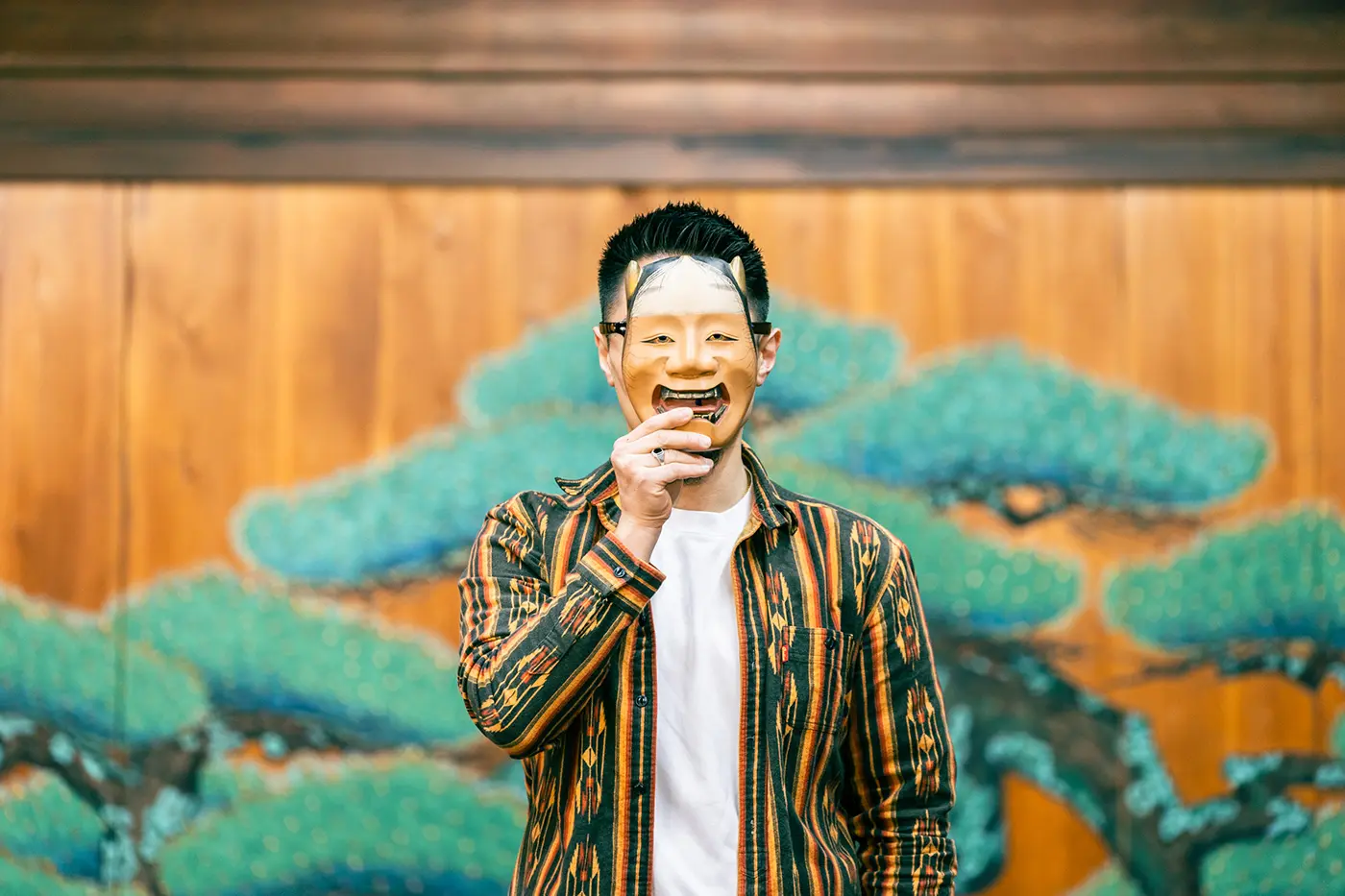

The performing arts culture of the Kansai region, which flourished during the Azuchi-Momoyama period (circa 1570), expanded into many genres, including Bunraku, Kabuki, and Rakugo. Noh, in particular, has a deep connection with Osaka, thanks to Toyotomi Hideyoshi's love for it. Kishiwada is home to the prefecture's oldest surviving Noh theater and a shrine housing Noh masks over 400 years old. This time, we explored the connection between Kishiwada and Noh with Noh mask enthusiast Soma Kurimoto.
Related Tours
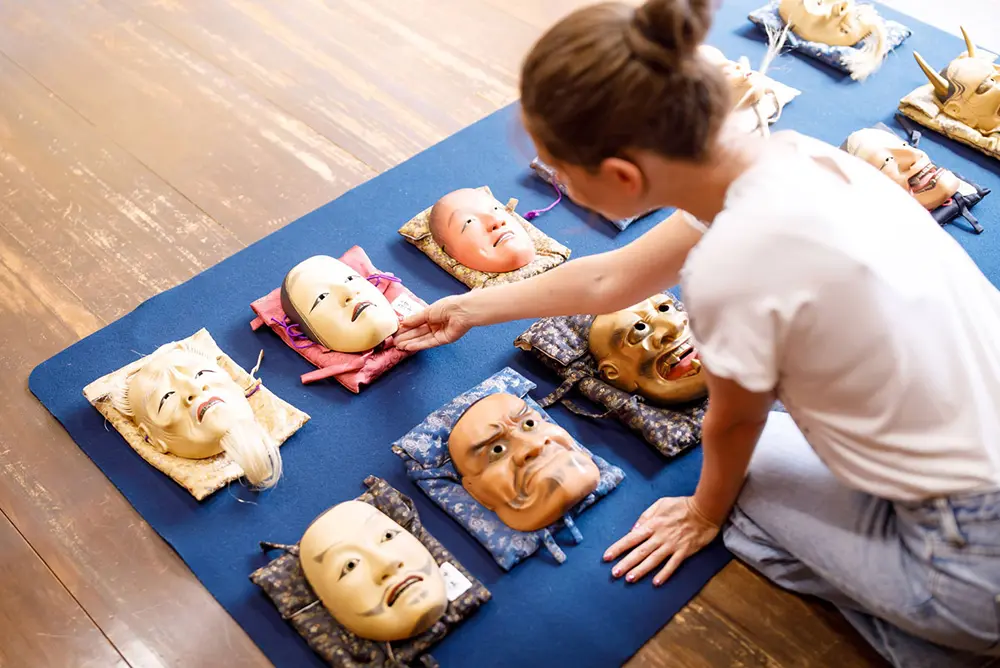
Cultural Tour of Osaka's Oldest Noh Stage and Kishiwada Castle
- Experience performing on stage at Sugie Noh Theater, the oldest surviving Noh theater in Osaka Prefecture
- Take a commemorative photo while holding and wearing a precious Noh mask
- Visit Kishiwada Castle, the symbol of Kishiwada
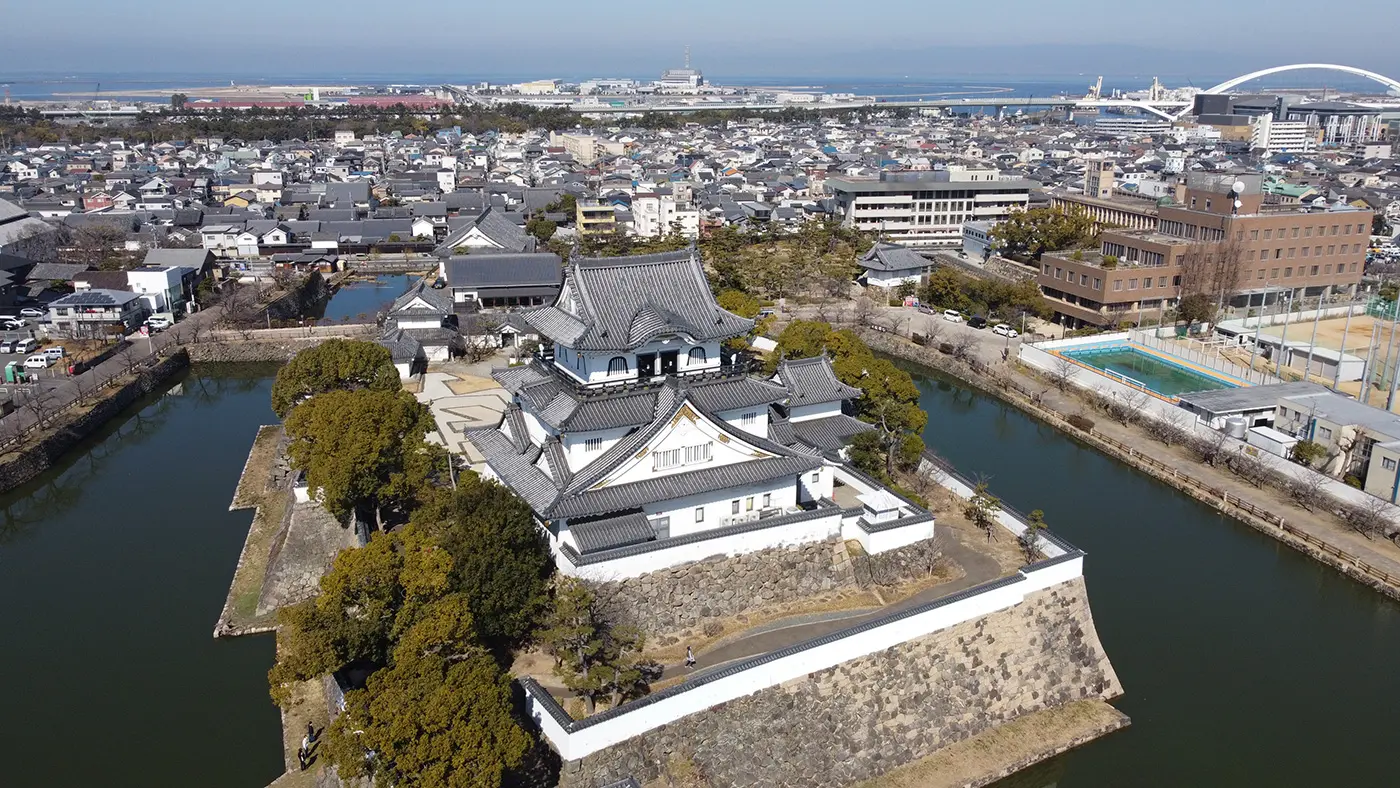
Kishiwada City, famous for its Danjiri Festival held every September and October, is home to many historical heritage sites throughout the city, including Kishiwada Castle, which served as the southern defense for Osaka Castle during the Edo period. Among these are artifacts related to Noh, a form of theatre with roots in China that was established in Kyoto during the Muromachi period. Noh fell into decline during the Sengoku period, but was revived under the rule of the samurai class, with Toyotomi Hideyoshi, a Noh enthusiast, having plays written featuring himself as the main character, and performing them himself at Osaka Castle and daimyo residences.
During the Edo period (1603-1868), the Okabe family, who were the lords of the Kishiwada domain, protected and encouraged Noh, and it is believed that many performances were held on the Noh stage within Kishiwada Castle.
During the Taisho era, Noh actor Sugie Oukoku received the bridge over the Noh stage within the castle from Okabe Nagamoto, the last lord of the Kishiwada domain, and built the Sugie Noh Theatre.
Additionally, at Hyozu Shrine, where Noh performances were dedicated to praying for rain, old Noh masks thought to date back to the Muromachi period are kept, conveying the connection between Noh and Kishiwada to the present day.
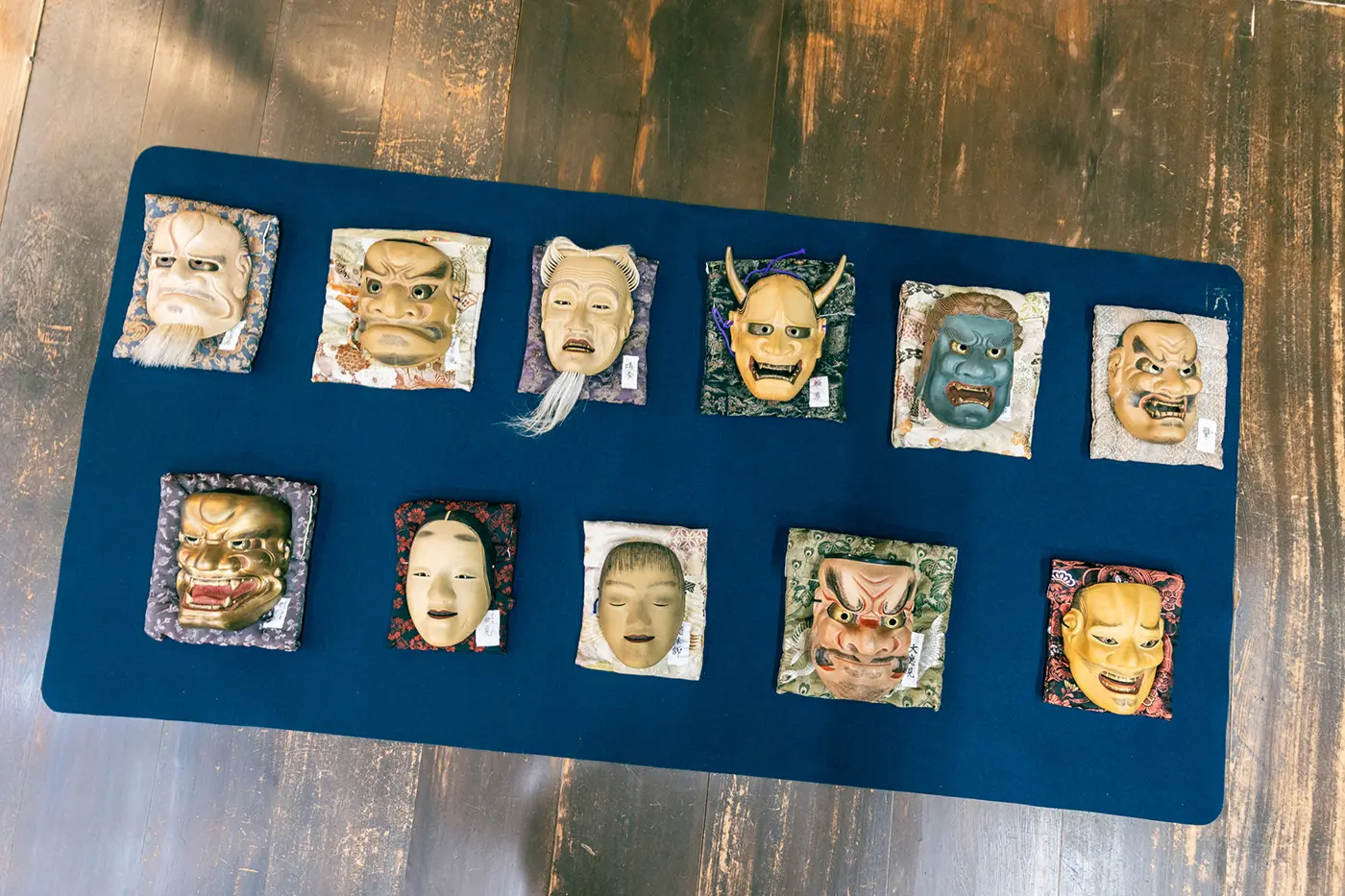
Noh masks are carved wooden masks worn by actors to play their roles, and they play a role in making characters from stories, as well as "non-human" beings such as gods, ghosts, monsters, and demons, manifest on stage through the performer's expressiveness.
Soma Kurimoto, a sales staff member at a vintage goods store in Americamura, Osaka, became fascinated with the mystique of Noh masks while handling them in the course of his purchasing duties, and has since become a collector himself. In this article, Kurimoto, who is fascinated by Noh masks, will travel around Kishiwada to visit the legacy of Noh theater and share with us an unknown side of Japan's cultural history.
Guide
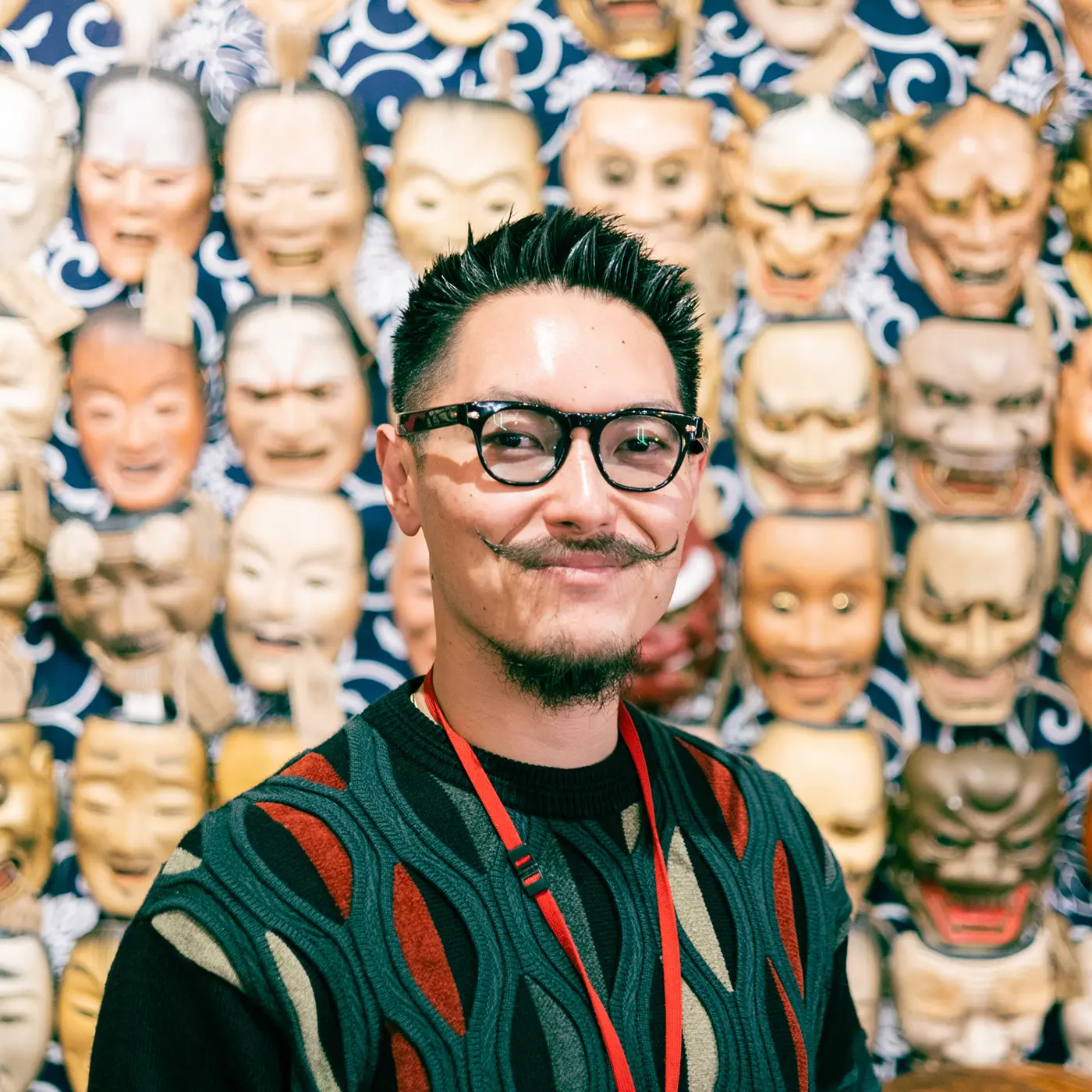
Born in 1994 in Kameoka, Kyoto Prefecture. He is currently a staff member at Americamura Flea Market BB, which handles vintage goods, where he is in charge of selling Japanese masks. He became interested in Noh masks in his early twenties, and is now a collector with around 40 masks at home. He also shares the appeal of Japanese masks on his shop's Instagram account, which is dedicated to Japanese masks.
Heizu Shrine: A Noh mask estimated to be over 400 years old is a shrine treasure
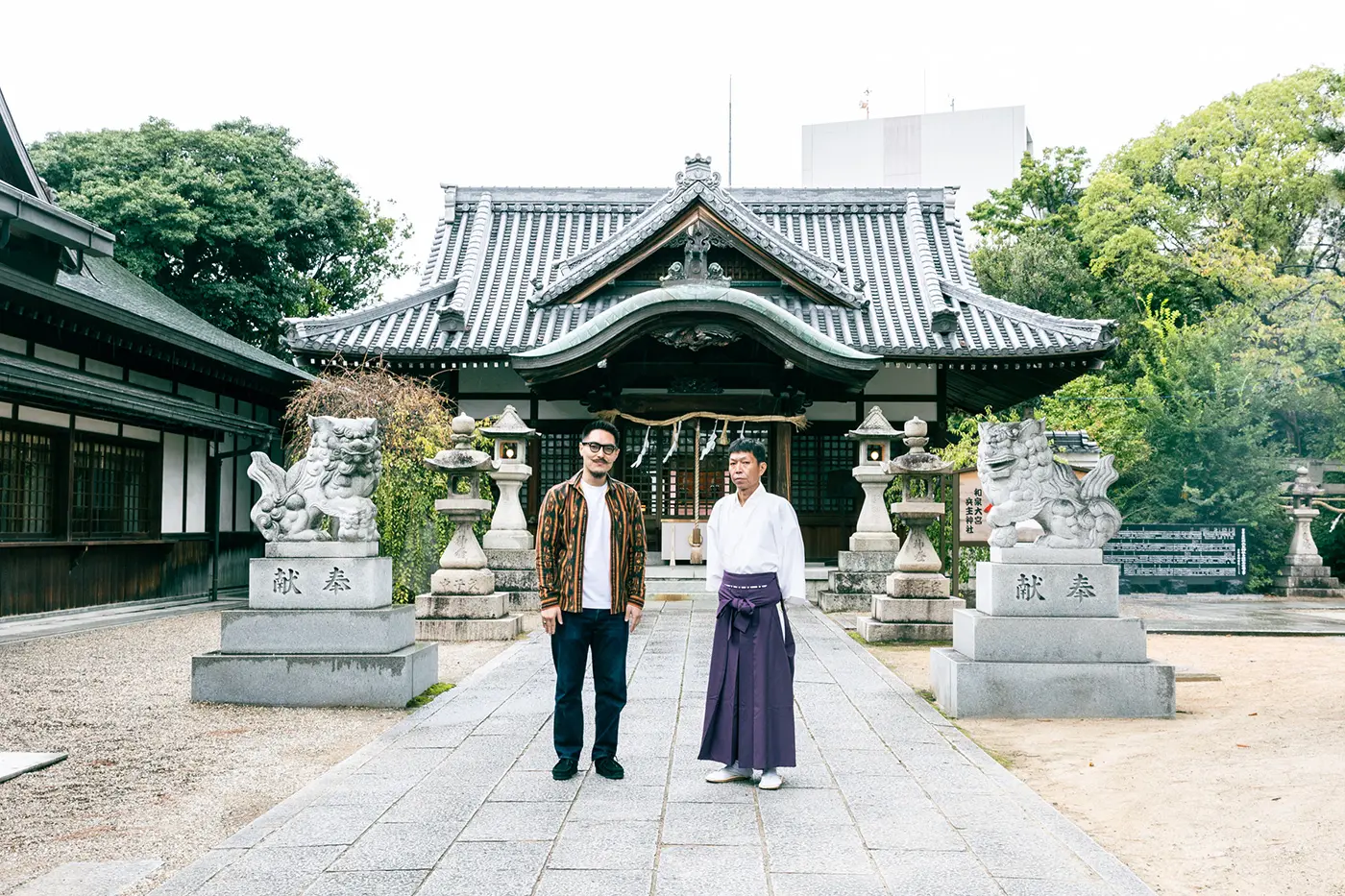
First, we visited Heishu Shrine in Nishinouchi Town, where Noh masks from over 400 years ago are kept.
It is said that this shrine already existed in this area during the Nara period, and its main deities are Amaterasu Omikami, who also appears in Japanese mythology, Hachiman Daimyojin, the deified Emperor Ojin, and Sugawara no Michizane, who is worshipped as the god of learning. During the Azuchi-Momoyama period, the shrine was invaded by Oda Nobunaga and Toyotomi Hideyoshi, and the buildings and most of the books within the temple grounds were lost, but the main hall, which was later rebuilt by Hideyoshi, has been designated an Important Cultural Property of Japan.
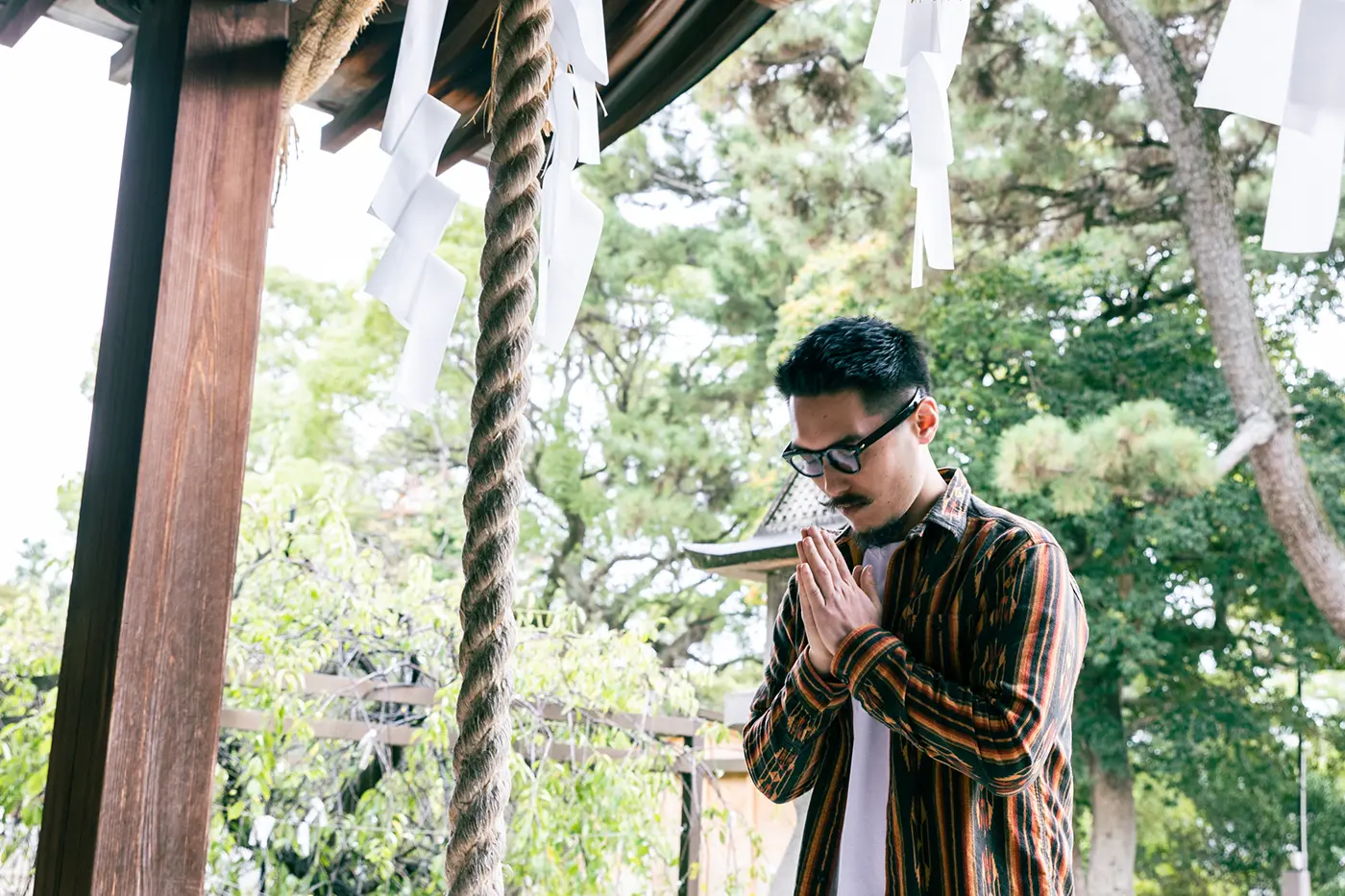
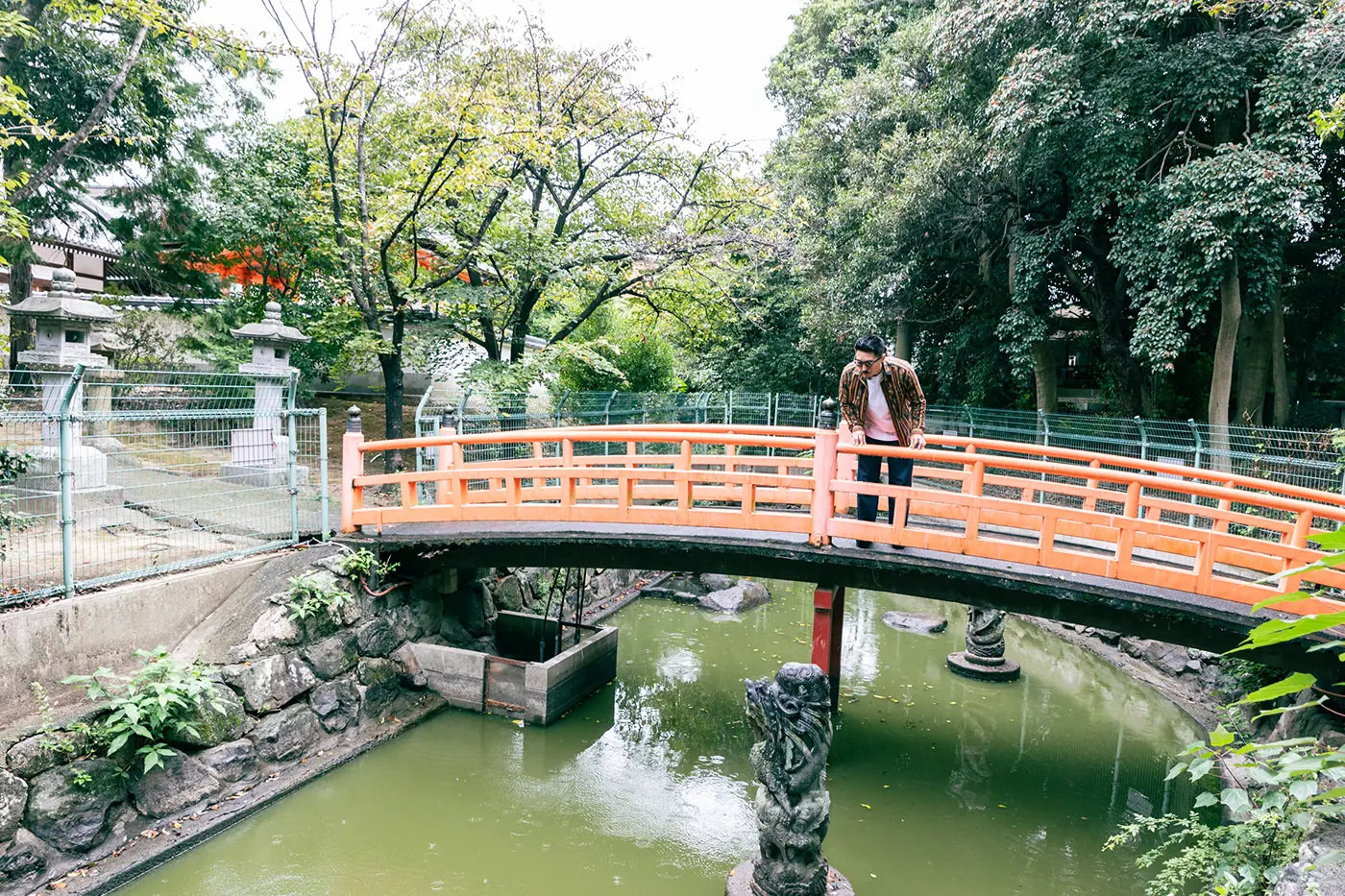
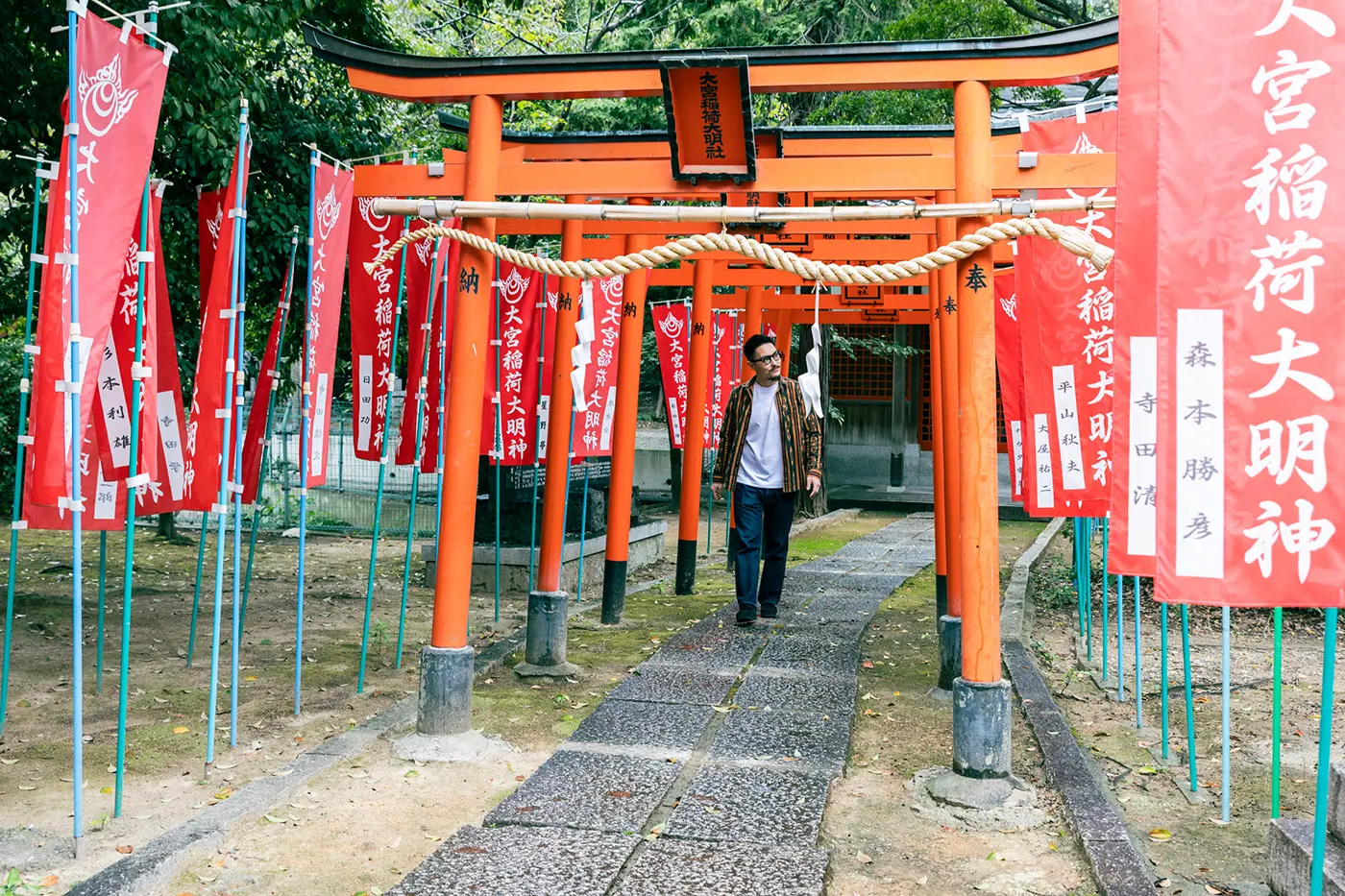
Before coming face to face with the Noh masks, you must first pay your respects to the gods. The spacious grounds are filled with a solemn atmosphere, and just walking around will make you stand up straight. In addition to the main shrine, there are various branch shrines, such as Omiya Ebisu Shrine, which enshrines Ebisu, the god of prosperity in business, and Itsukushima Shrine, which enshrines Benzaiten, the god of waterside activities, so you can make almost any prayer you want in Kishiwada by coming here. At the back of Hebibuchi Pond, there is also a chozuya (water purification fountain) where you can pray for safe childbirth and recovery from illness.
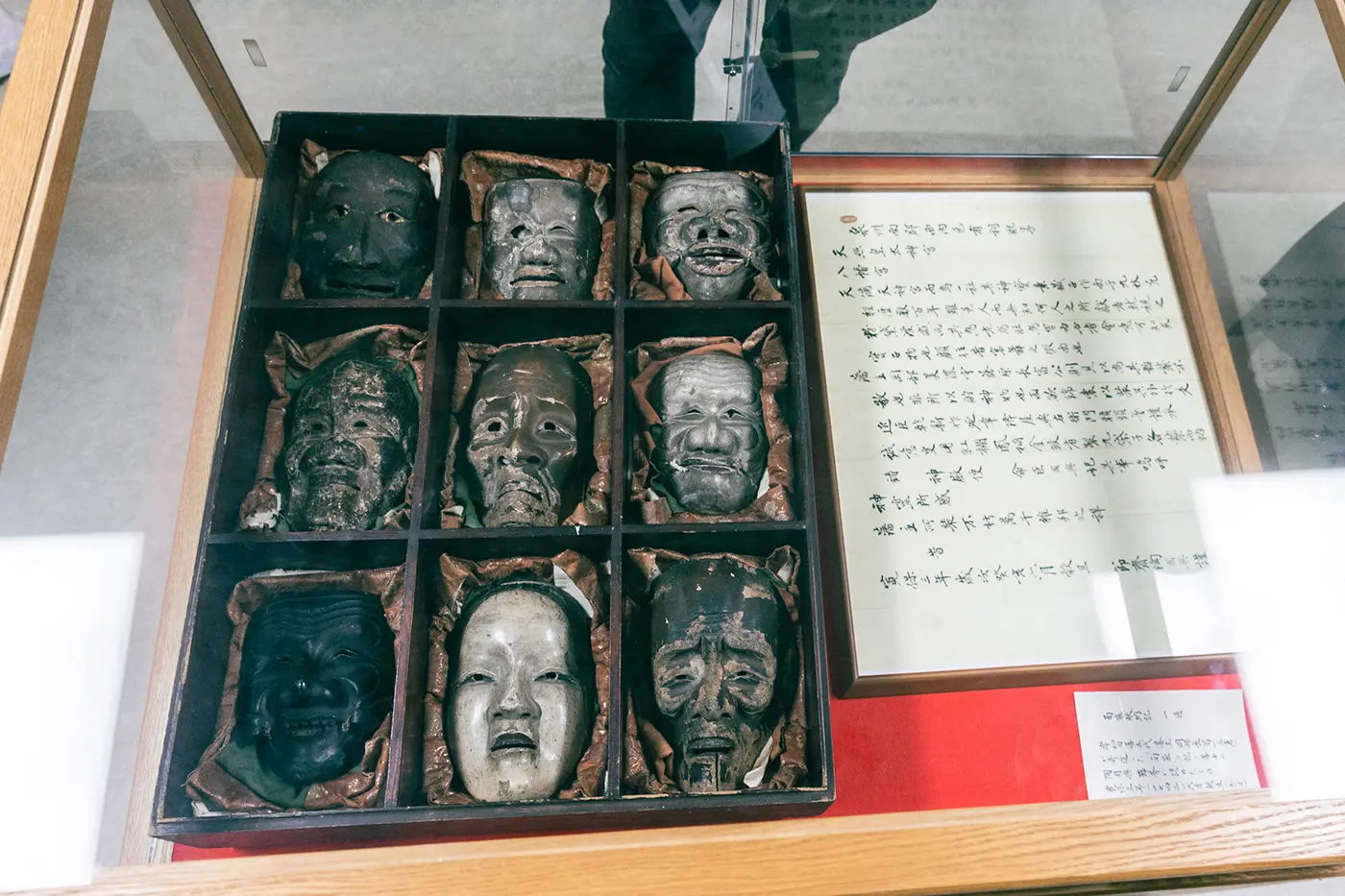
Nine Noh masks that tell the story of the early days of Noh
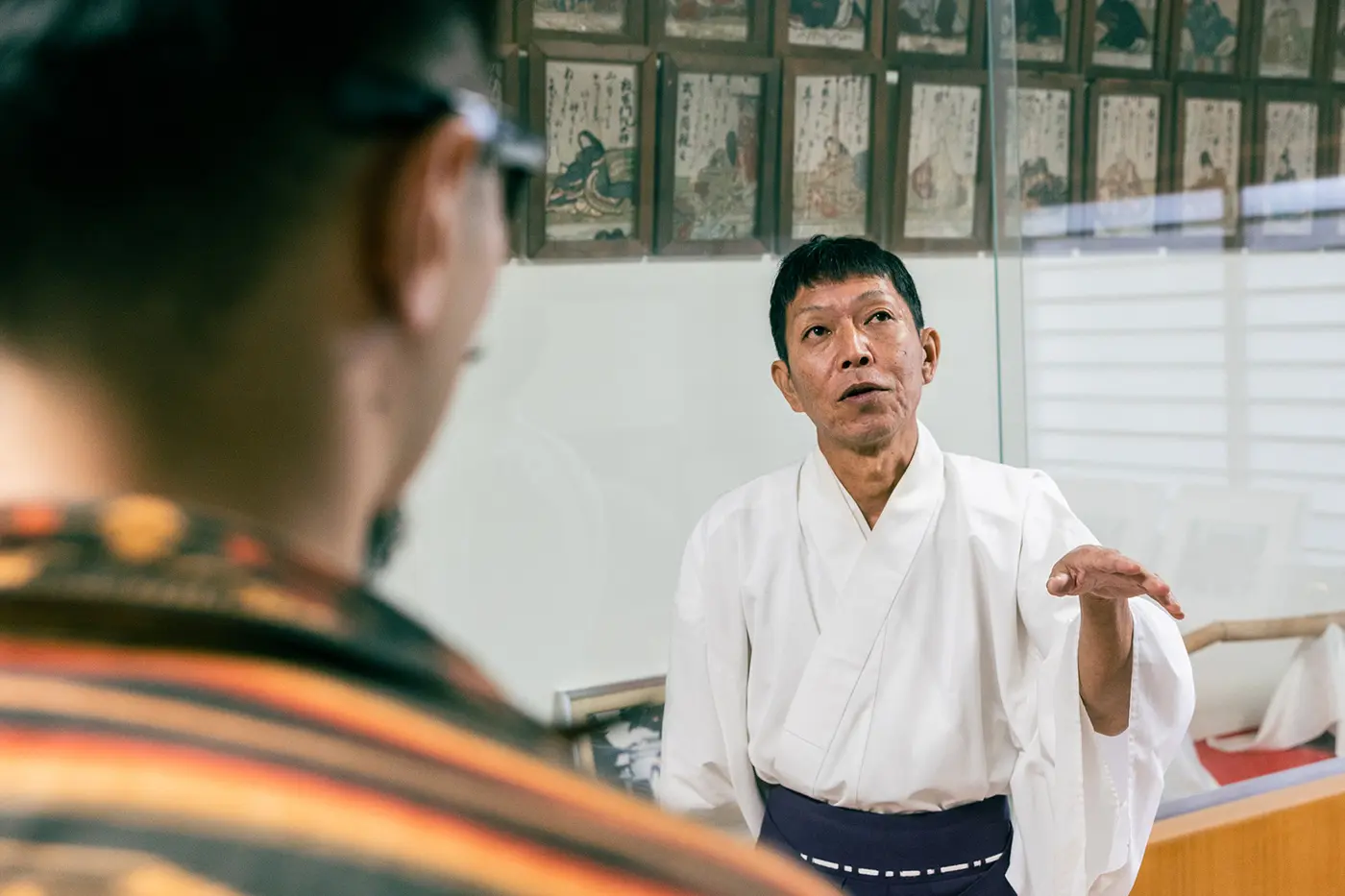
After praying, we finally headed to the storage room in the shrine office where the Noh masks are kept. Before we did, the chief priest, Murata, explained to us about the relationship between Hyōzu Shrine and Noh.
According to legend, a child from Nishinouchi village set a dog on the shrine grounds to catch a fox, a messenger of the gods. The gods were sorrowful that they stood at the head of the village and warned him that they would destroy the village.
Kurimoto-san! God is merciless.
They had laid hands on the chief priest's messenger, Murata... In order to appease the anger of the gods, the villagers performed a 'Shojin Kessai' (abstinence ritual) to purify their bodies and minds by abstaining from alcohol and meat for a week, and on the day they had finished their duties, they found a Noh mask in front of the shrine.
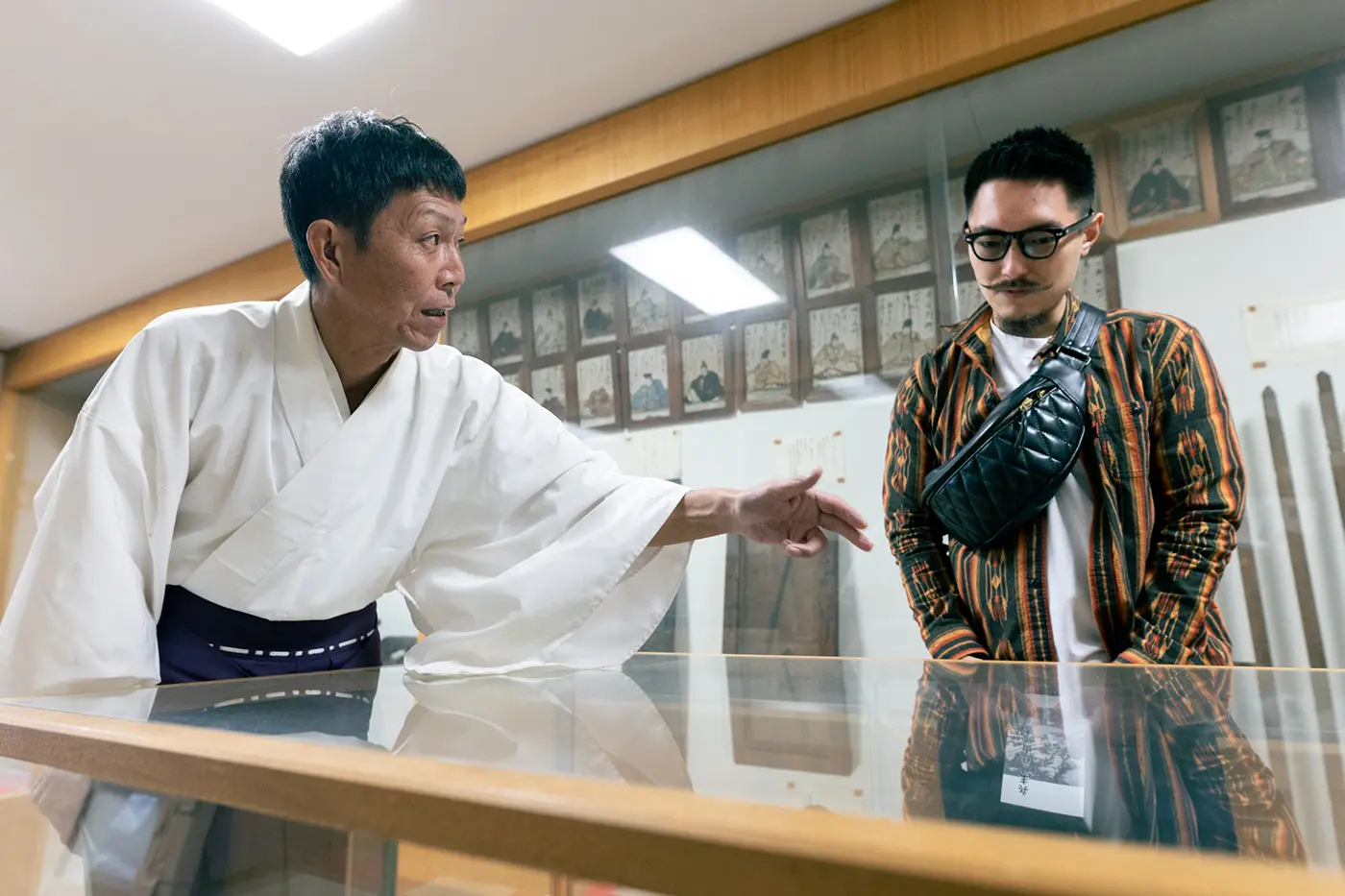
Kurimoto-san, is that by any chance the Noh mask that is said to be kept here?
Priest Murata: There are no documents or materials left to prove this, but it's possible. The villagers thought the mask was a blessing from the gods, so they kept it at the shrine and began to offer Noh performances to express their gratitude. However, this tradition is said to have disappeared after the invasions by Oda Nobunaga and Toyotomi Hideyoshi and the battles over Kishiwada Castle.
Mr. Kurimoto, what are you doing to Nobunaga and Hideyoshi...?
Currently, nine Noh masks are preserved, and although it is not known whether they are the same as the masks in legend, they were apparently already kept at the shrine during the Muromachi period. This means that masks from over 400 years ago have been preserved in their original state.
Chief Priest Murata: In the Edo period, when a Shinto ritual such as a rain-making ceremony was to be performed, it was necessary to apply to the feudal lord. When the use of Noh masks was also reported, Nagatomi Okabe, the lord of Kishiwada at the time and known to be a fan of Noh, made the effort to come and inspect the shrine.
Mr. Kurimoto and Mr. Okabe, although they said they were inspecting the place, they just wanted to have a normal look.
As the head priest of Murata Castle, he probably couldn't reveal it publicly, but that may have been the case (laughs). Lord Okabe believed that this Noh mask was a sacred object and should not be treated carelessly, so in 1743 he had a paulownia wood box and a brocade mask bag made to store the mask and donated them to the shrine.
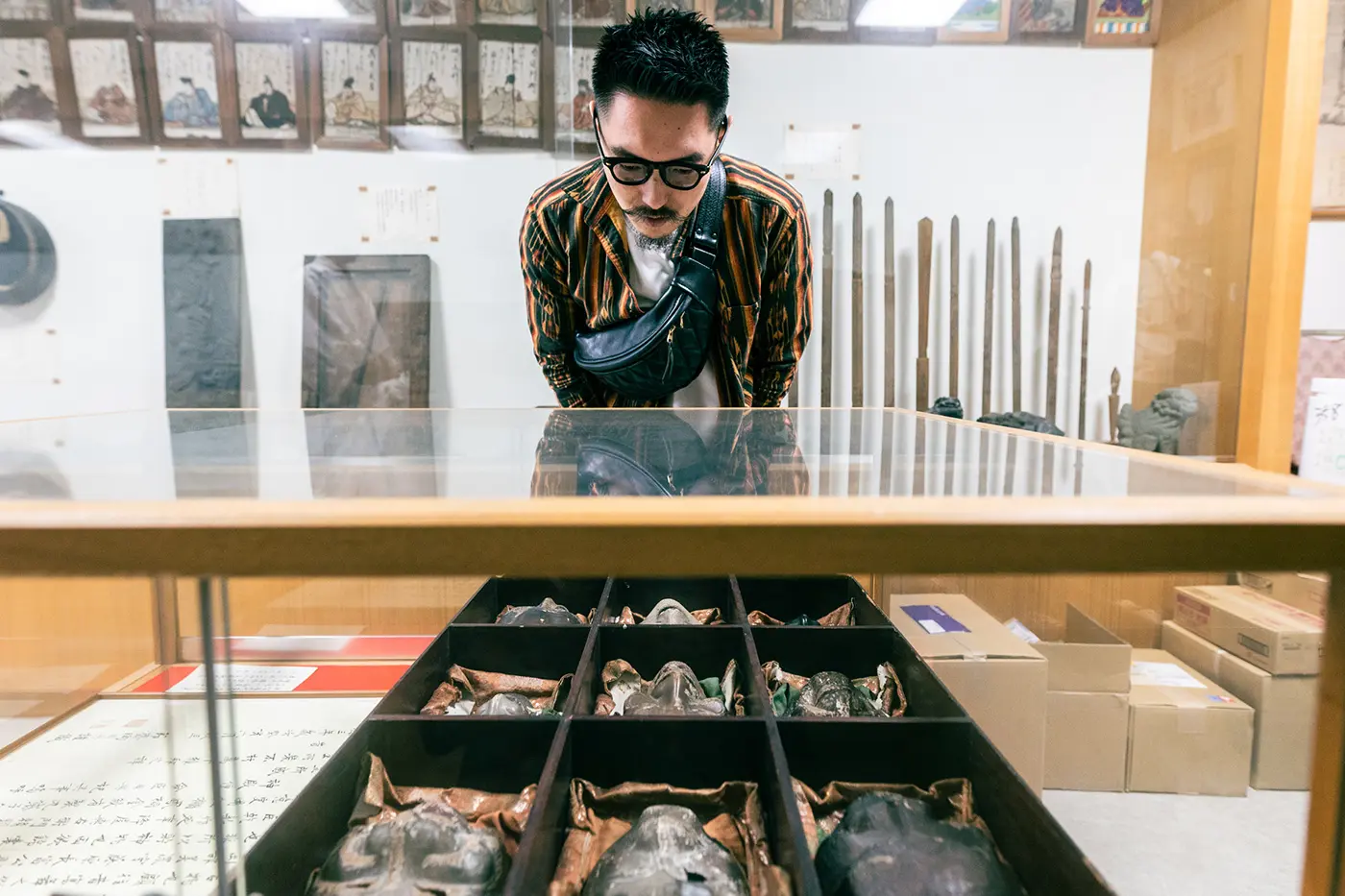
Eight of the nine Noh masks are made of wood and one is made of paper, and it's amazing how well preserved they are, considering they're over 400 years old. Although Kurimoto has seen many Noh masks in his life, he couldn't hide his excitement at seeing this precious treasure for the first time.
There are two approaches to making Noh masks: those that stand alone as works of art, and those that are effective on the Noh stage, and I believe these nine masks are definitely the latter. They express the characters more directly than the Noh masks I own, and I feel that the simple construction reflects the pure feelings that people have entrusted to the masks.
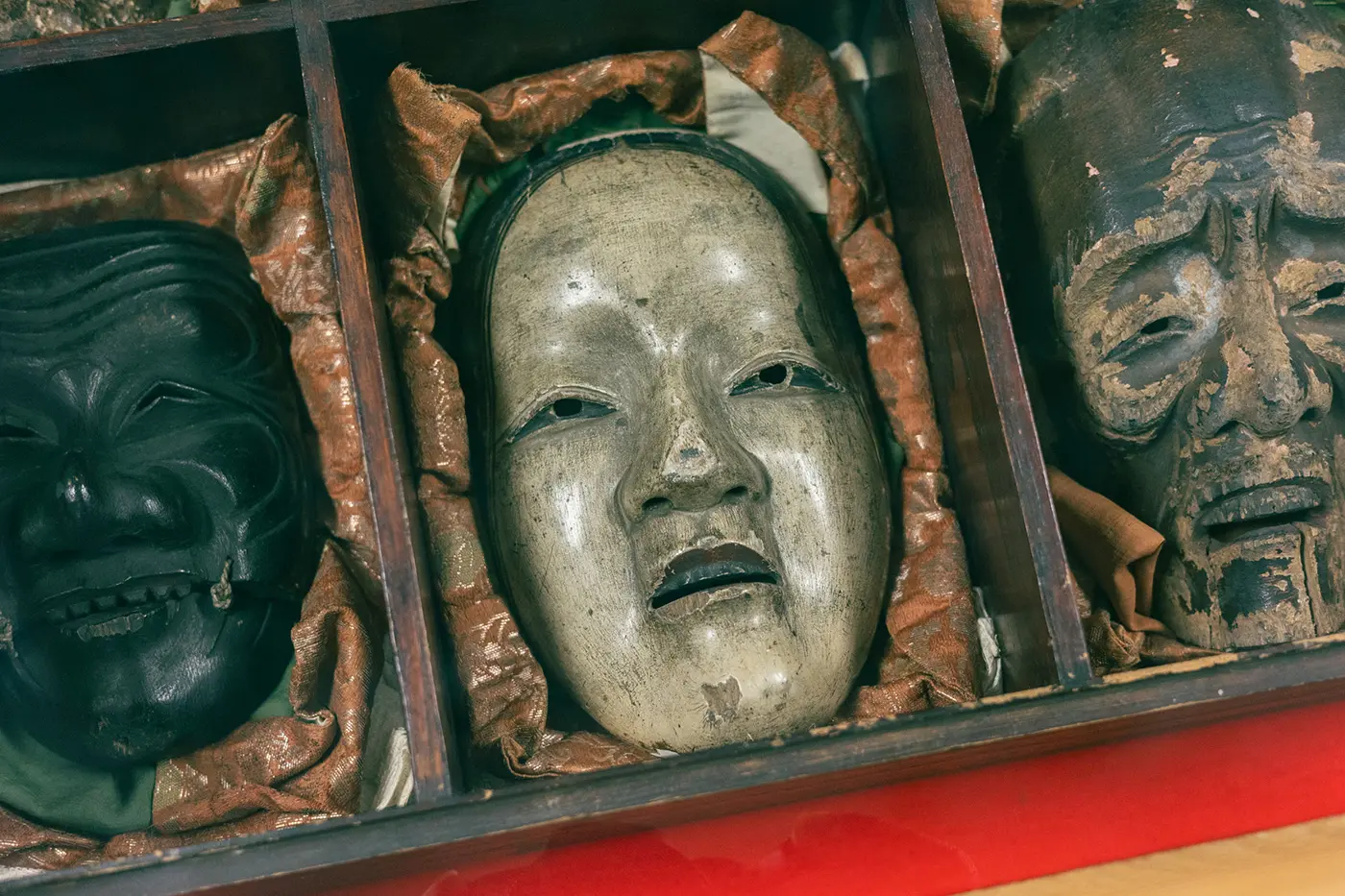
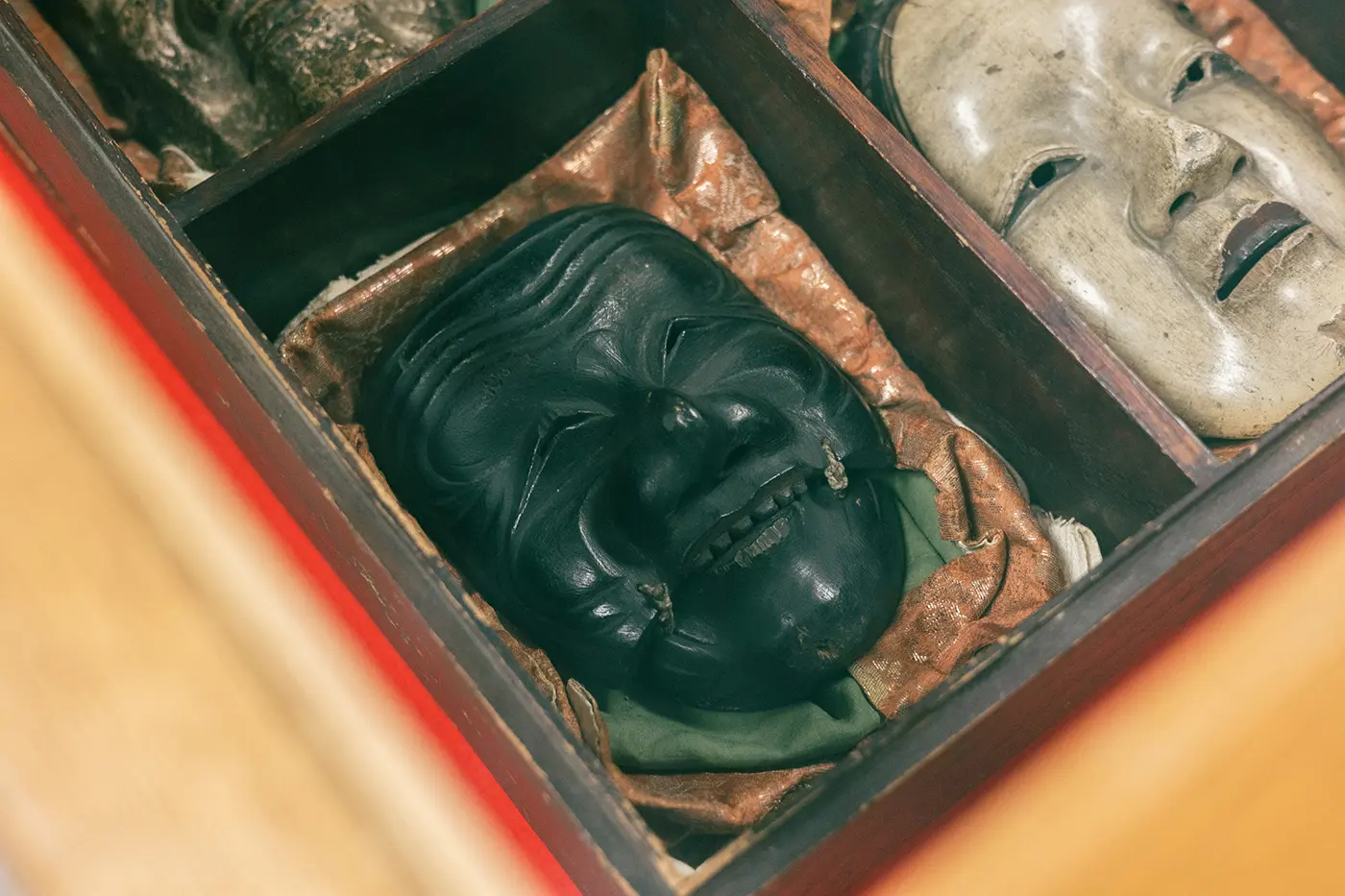
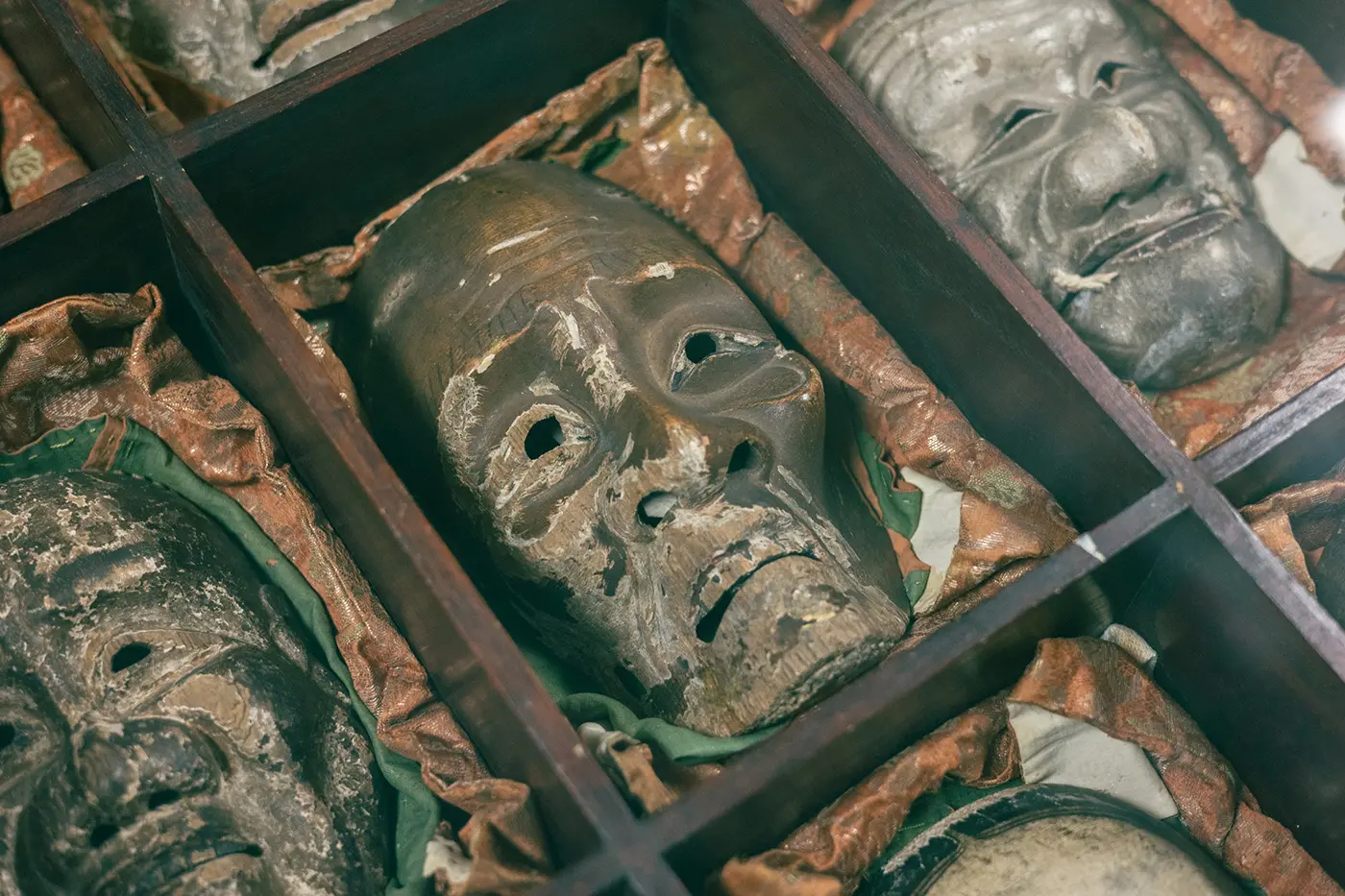
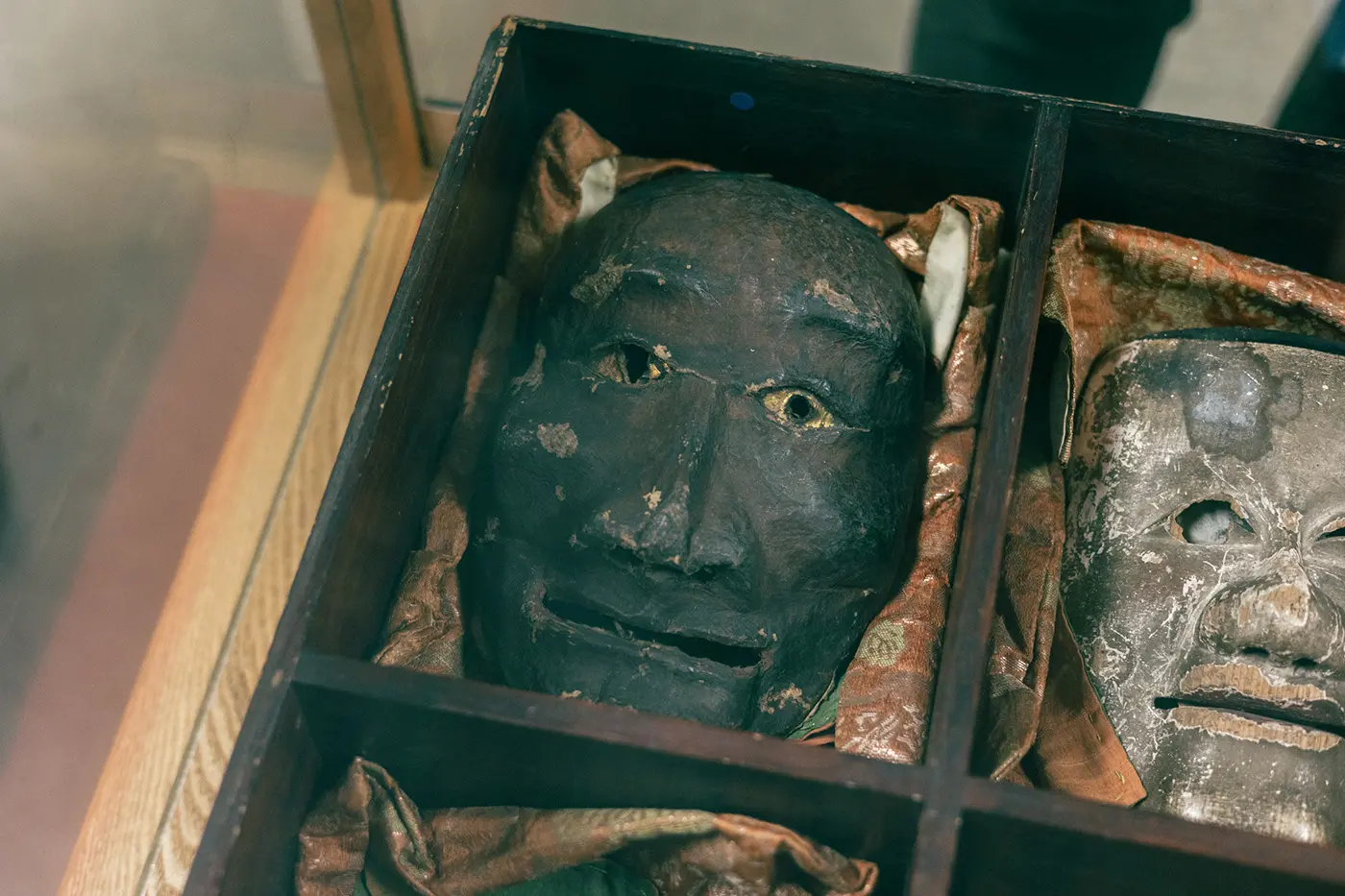
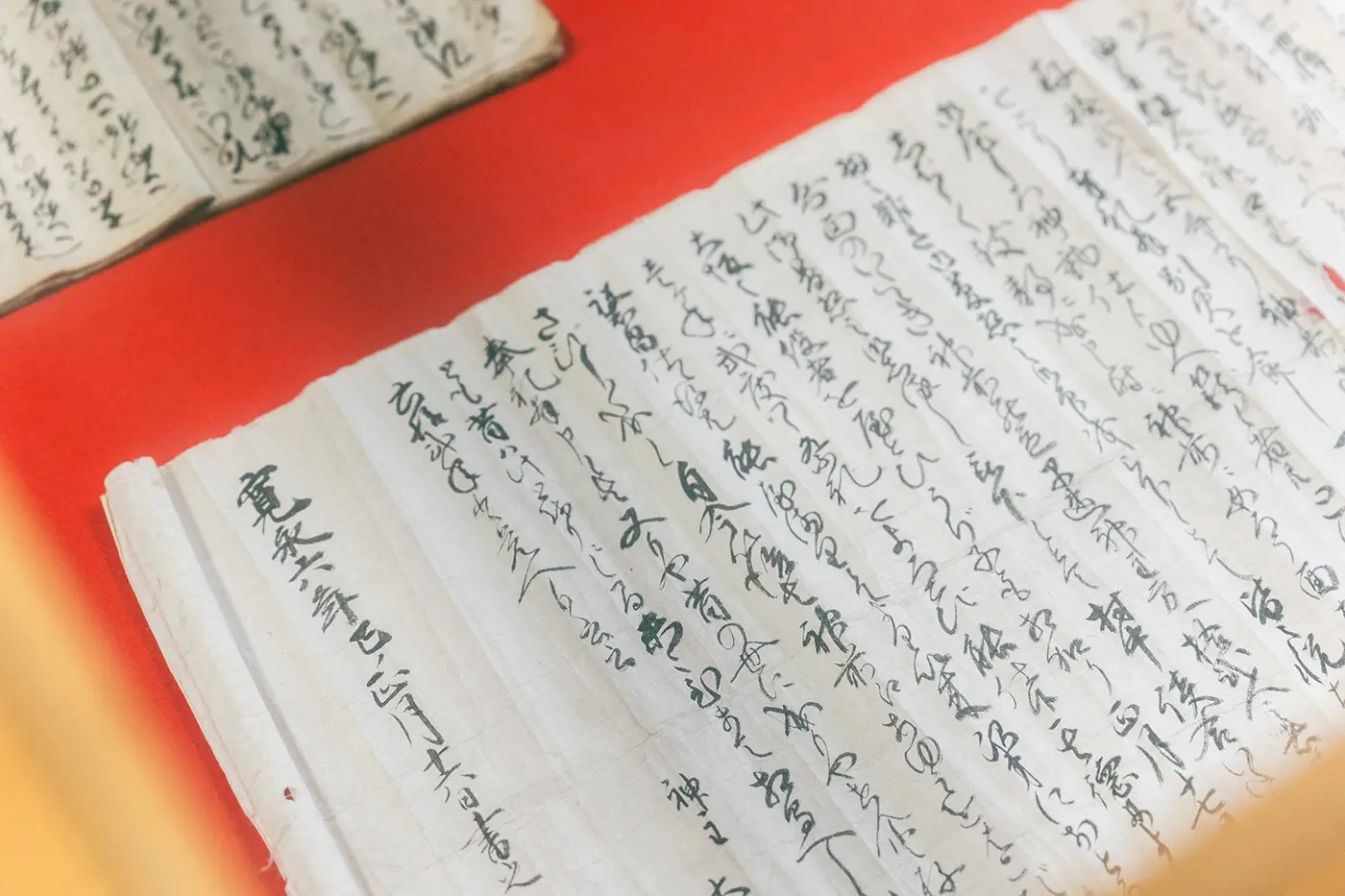
Records of the Noh masks at Hyosuji Shrine have been lost, so the details remain a mystery. However, when I saw the real thing, I didn't care about that at all, as I felt the energy radiating from them and was excited, thinking, "I'm witnessing something incredible!" Since you can only see these precious treasures by making a reservation in advance, if you're a fan of Noh, you have no choice but to go.
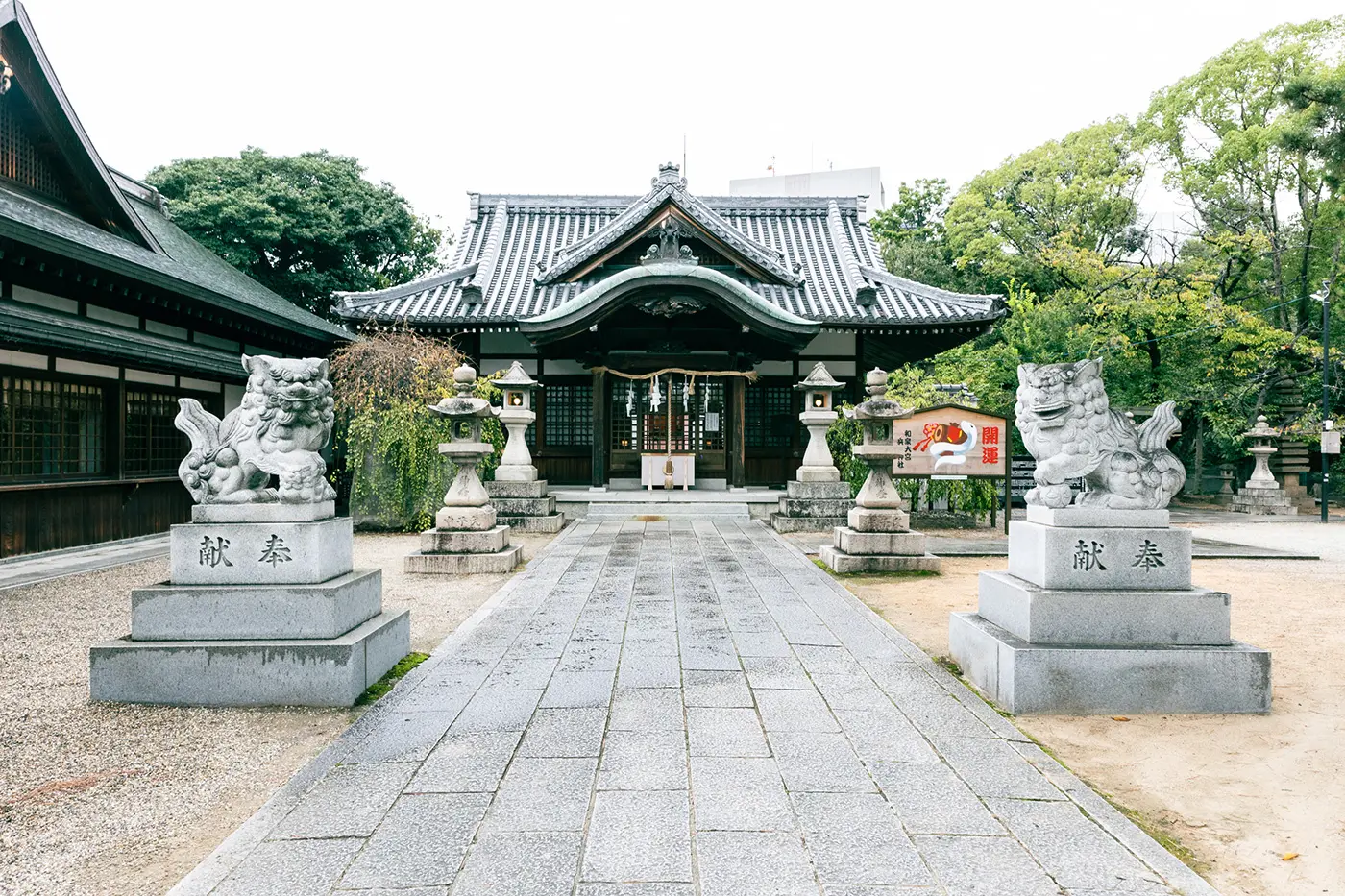
Reservations are required to view the Noh masks
Sugie Noh Theatre: Experience a Noh performance at a cafe housed in a Noh actor's home!
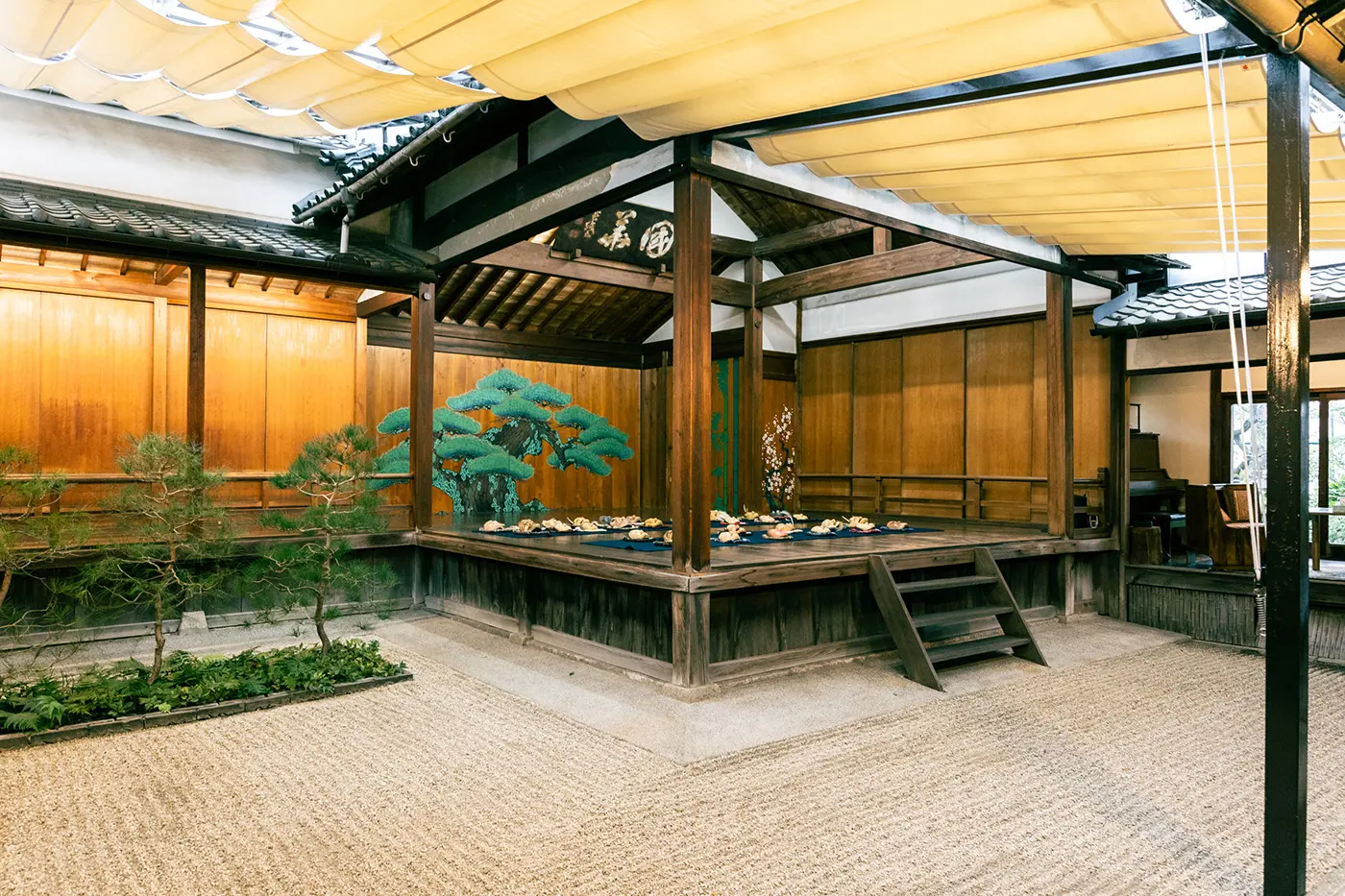
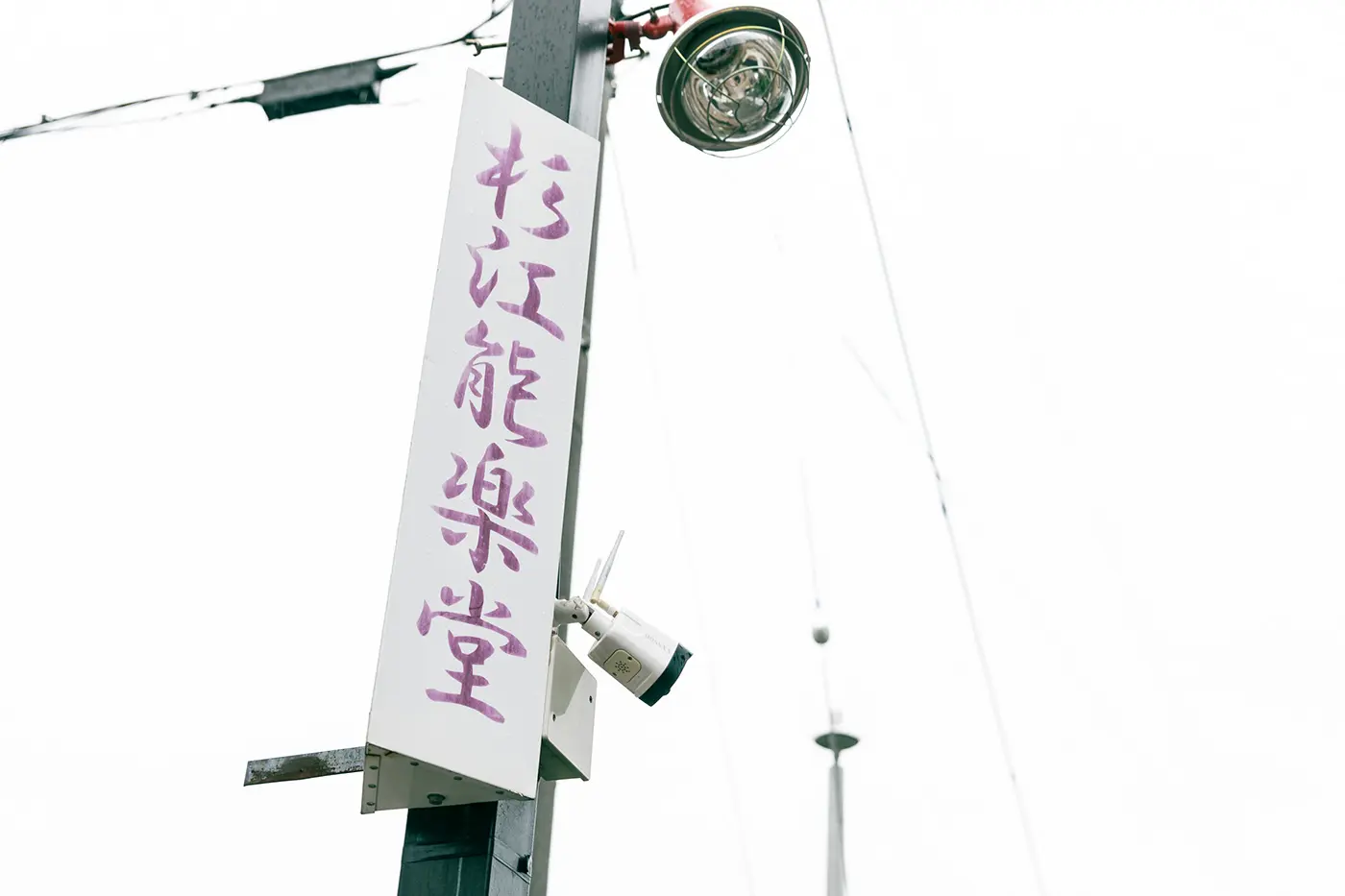
Next, we visited the Sugie Noh Theatre, located close to Kishiwada Castle. This is the oldest Noh theatre still standing in Osaka, and as mentioned in the previous section, it was built in the Taisho era by Sugie Sakurakuni, a Noh actor of the Kanze school, who donated the "hashigakari" (bridge-like passageway) of the Noh stage that was located within Kishiwada Castle to his own residence.
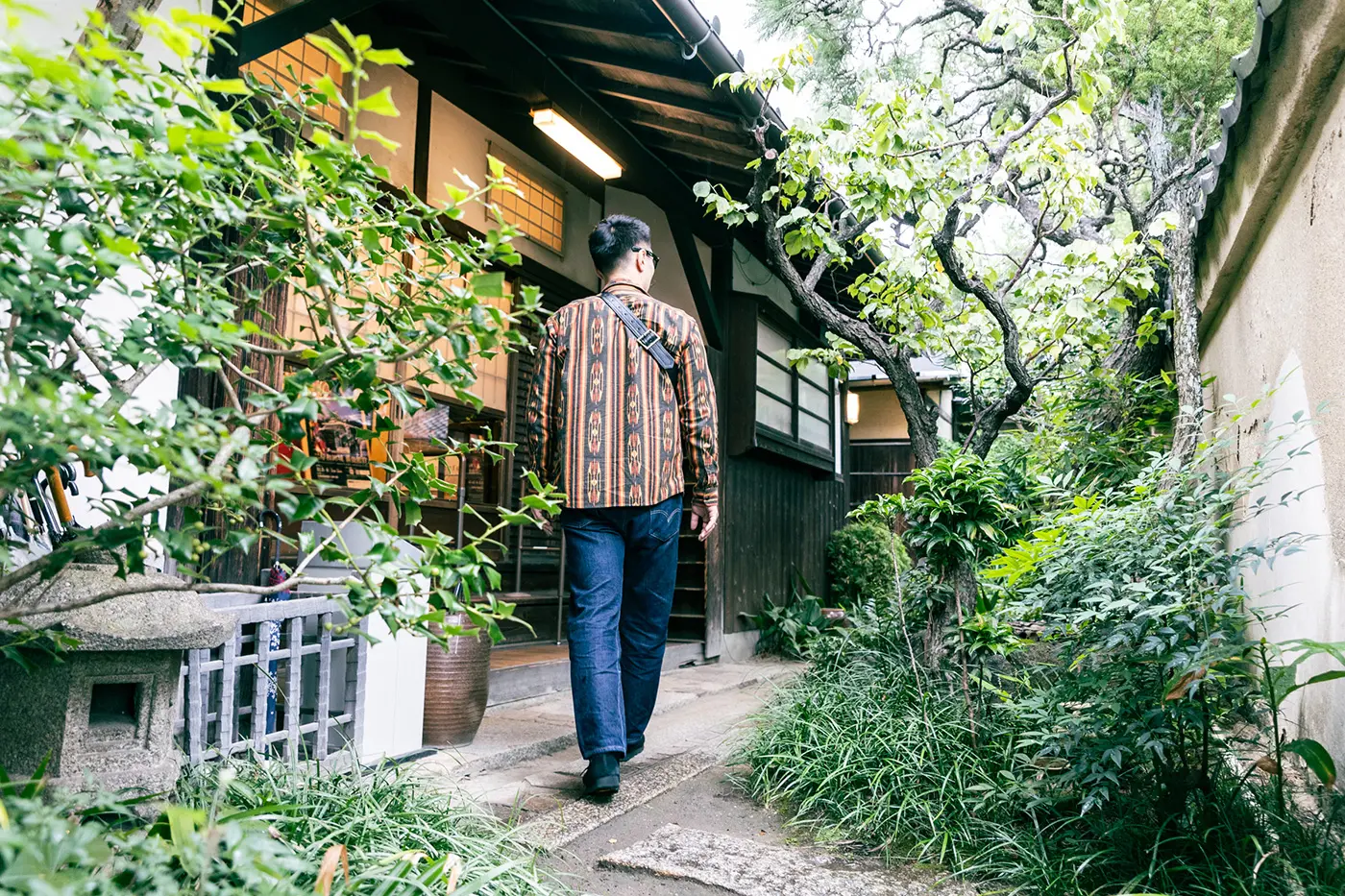
Looking at the exterior, you would never guess that there is a Noh stage inside the hideaway Sugie Noh Theatre. Once you pass through the gate, you will find a well-maintained garden that exudes elegance.
This was my first time in Kishiwada, and I'm ashamed to say that I had no idea that the area had such a strong connection to Noh. It felt like a dream to be able to enter a building where a Noh actor once lived. And there's even a Noh stage inside! It's so amazing that I can't quite comprehend it. Even though it was the Noh mask that got me here, I wonder if it's ok for me to have such a valuable experience...
View around 30 different Noh masks on the Noh stage
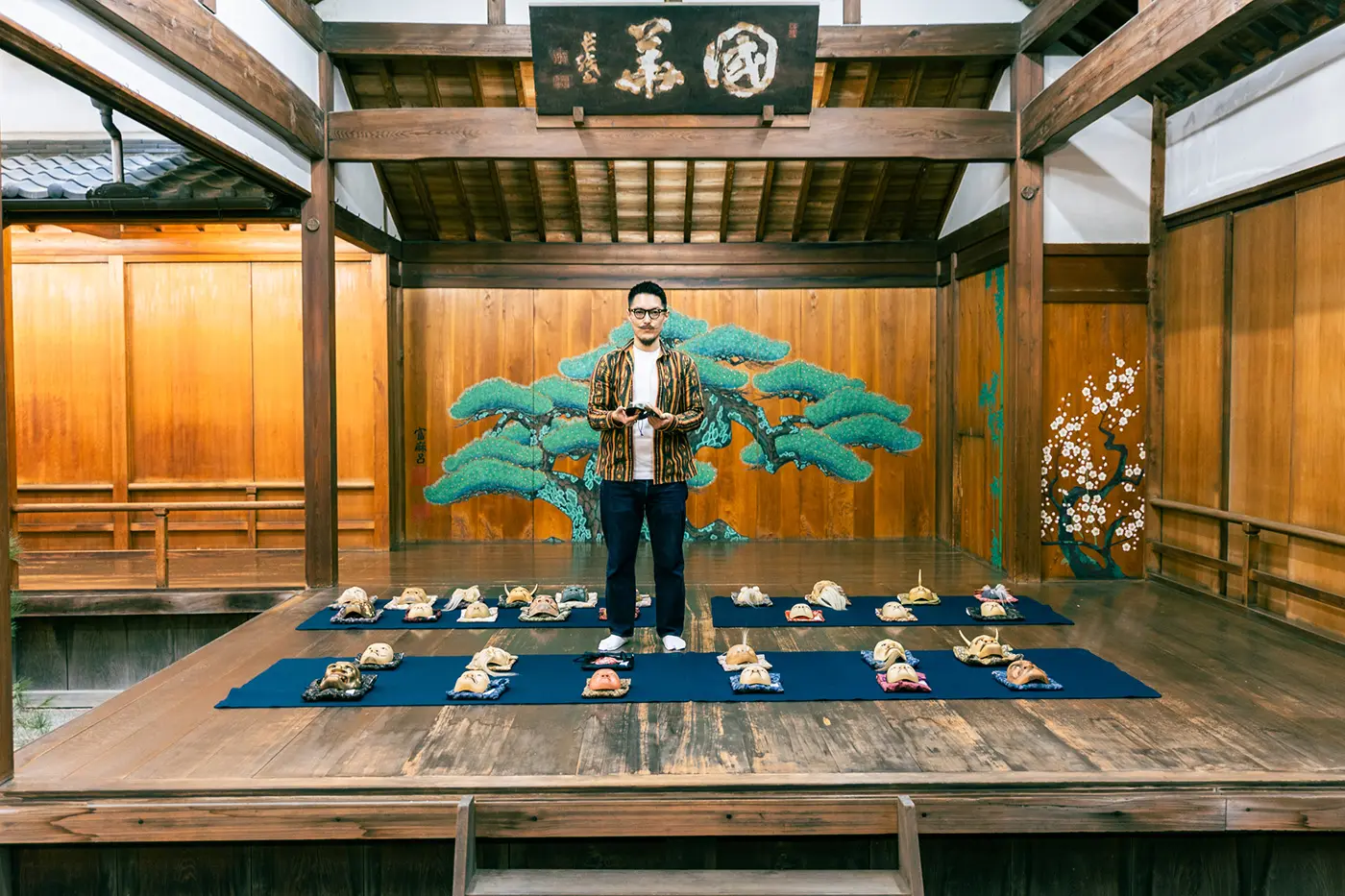
The Sugie Noh Theatre, which had long been closed to the public, was designated a national registered tangible cultural property in 2022, 105 years after its construction. In recent years, a project has also been launched to utilize the building and pass it on to future generations. Crowdfunding was also carried out, and with the proceeds, workshops and events using the Noh stage were held. Currently, the theatre is home to the restaurant MYOJYUNKA, which provides a space where you can enjoy a meal while watching the Noh stage.
Inside the restaurant, the Shirasu tree in the front garden, the three pine trees planted in the ground, and the rustic stage create an extraordinary atmosphere.
For this interview, approximately 30 Noh masks from the Sugie Noh Theater's collection were specially arranged on the stage for Kurimoto to enjoy to his heart's content.
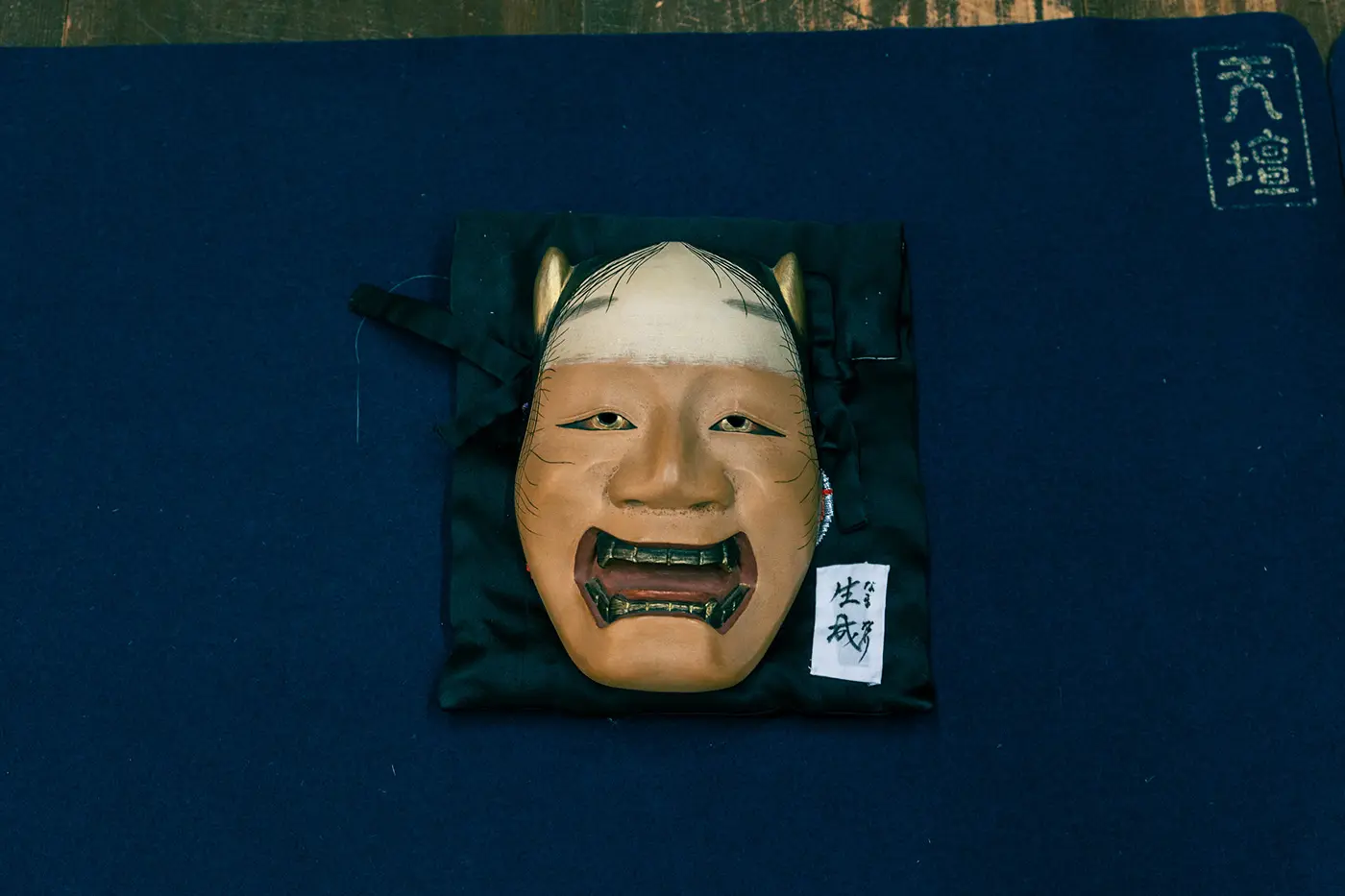
This is a Namanari mask that Kurimoto particularly likes and collects. It depicts a woman transforming into a demon while still alive, and is characterized by its vacant eyes.
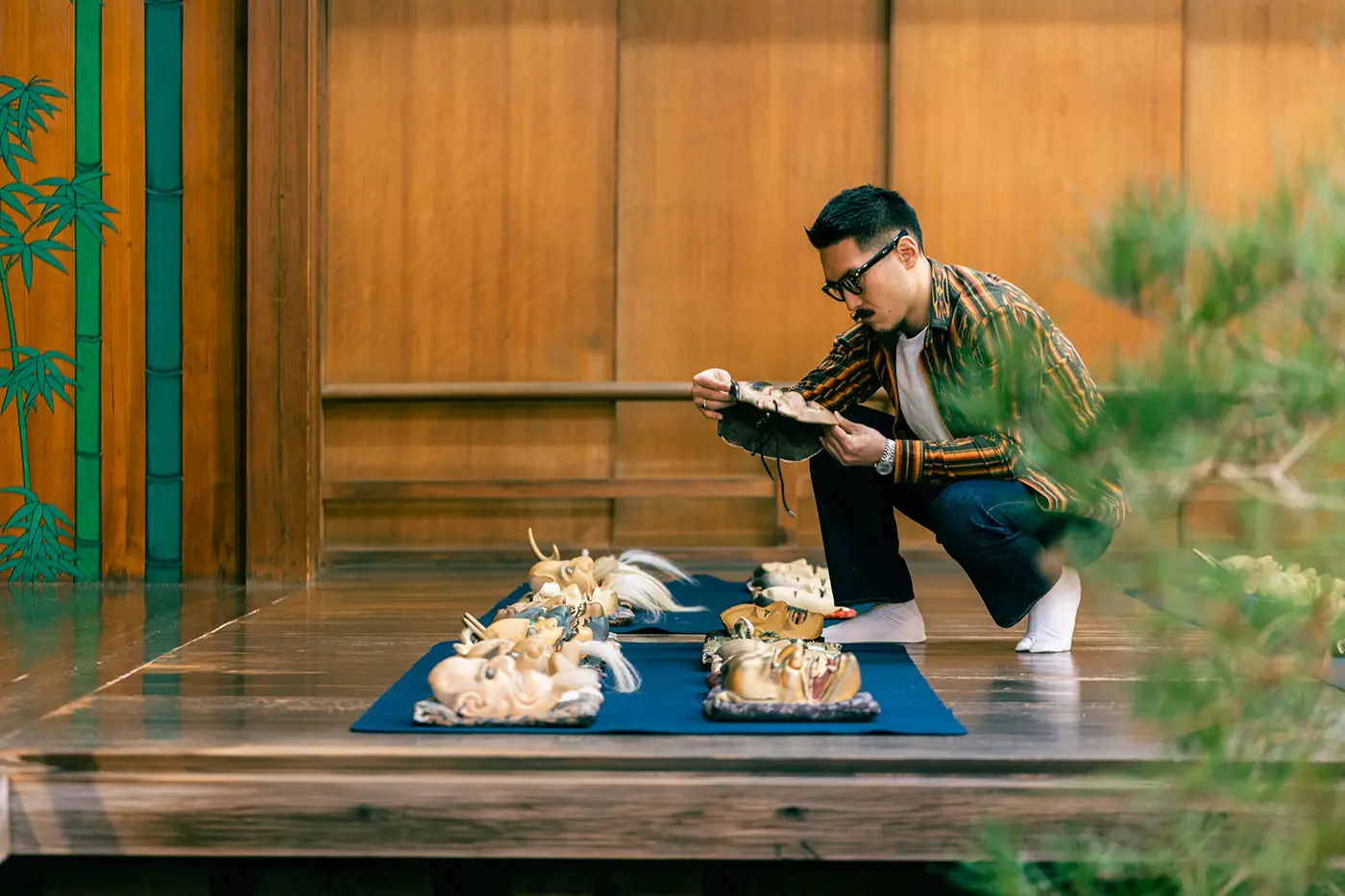
On stage, Kurimoto gazed intently at each mask. He also found some of his favorite masks, such as Shojo, the sake-loving fairy, and Kobeshimi, the demon of hell, and spoke of his feelings about them.
The Shojo is a mythical creature that lives in a pond and is unique in that its face remains red all the time. The Kobimi is an incredibly strong demon from hell and is used when playing the role of King Enma. The Ootobide mask is said to be the face of Sugawara no Michizane when he becomes a vengeful spirit and goes into a rage. It is a very popular mask and sells out as soon as it arrives in my shop.
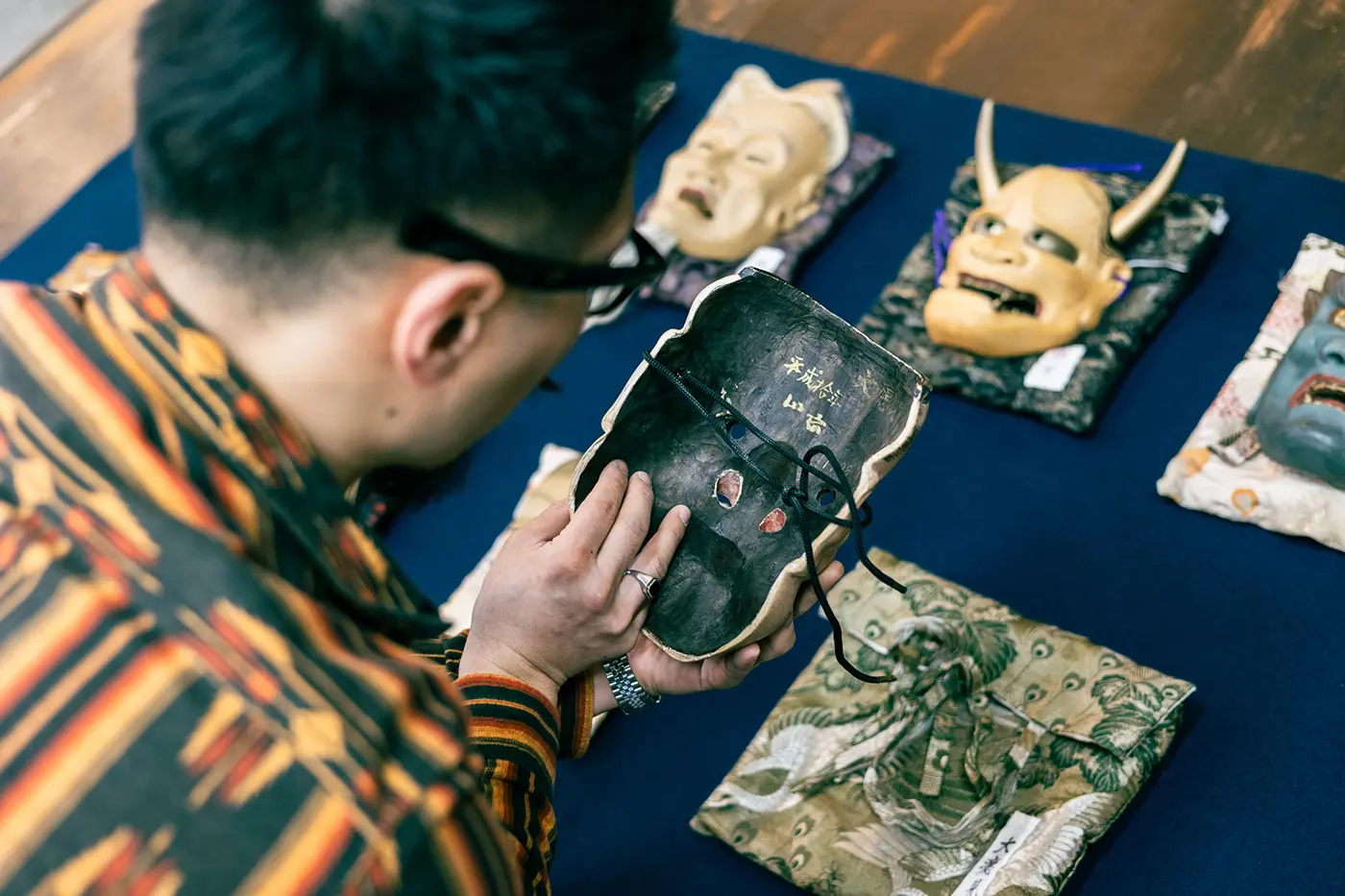
These Noh masks were made by a person who had studied Noh for many years, and were donated by his family after he passed away. Mr. Kurimoto is deeply moved by the passion of someone who has made so many Noh masks on his own.
There are many Noh mask craftsmen, but I have never seen one that has reached this level of quality, made for the purpose of personal research. The detailed work, such as the placement of the hair, is extremely meticulous, and I think it is amazing that they have been able to create a wide range of masks without being biased towards a single genre. It is truly an uplifting experience to be able to appreciate Noh masks like this on a Noh stage that I have seen countless times on DVDs and videos. The stage is filled with a sacred atmosphere, and the creaking of the floor that is transmitted with every step makes you feel the weight of history.
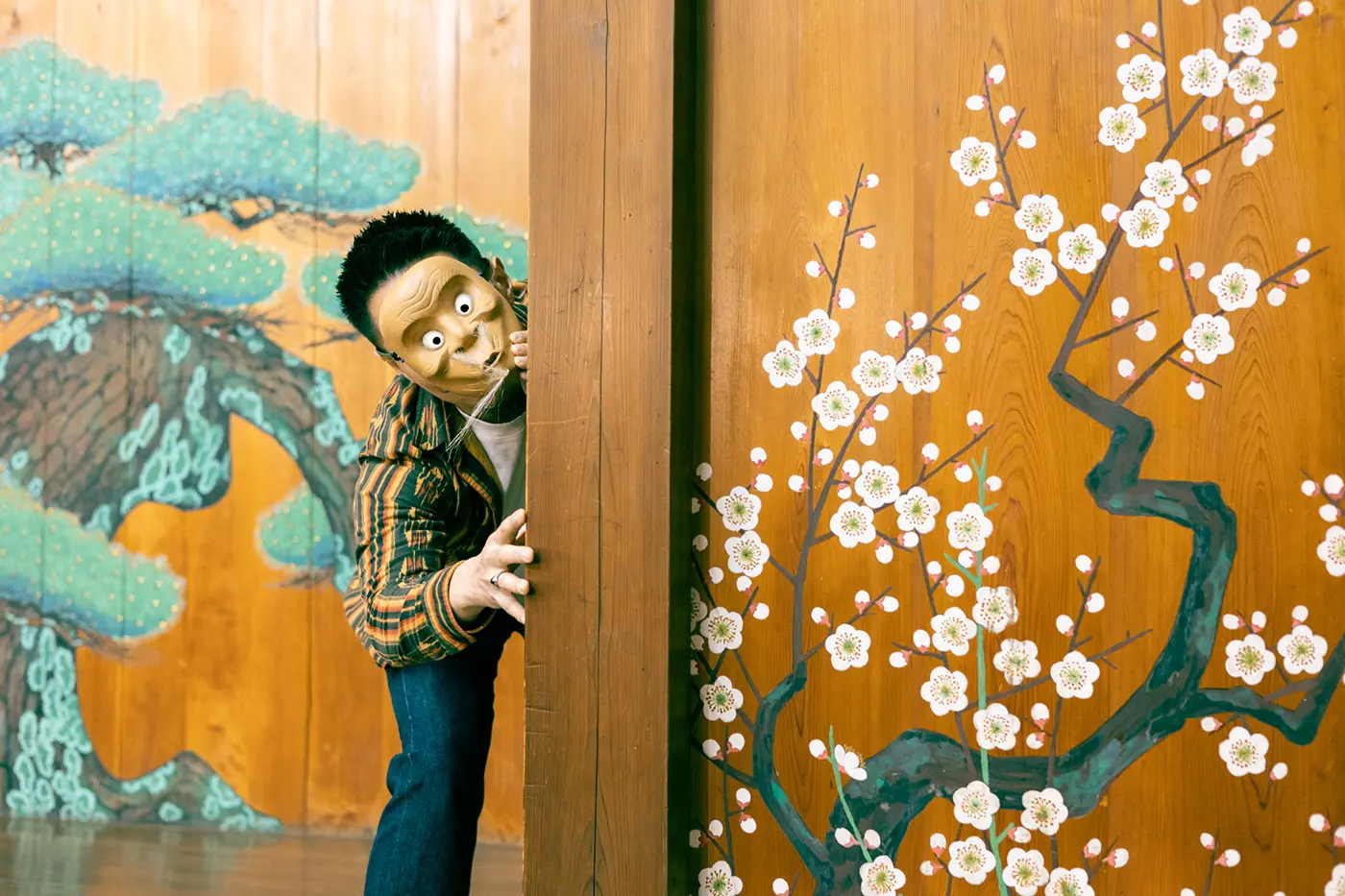
Kurimoto was even allowed to pick up a Noh mask and put it on, which got him even more excited, and he posed with his favorite mask.
At first glance, this mask looks like a Hyottoko mask, but it is called a Usofuki mask and is used when playing spirits such as mosquito spirits and octopus spirits. In Noh, there are characters such as demons, gods, and spirits as well as humans, so Noh masks are a tool that connects reality with the other world. I sometimes wear masks from my collection at home, but wearing one on the Noh stage gave me the feeling of becoming even more "non-human."
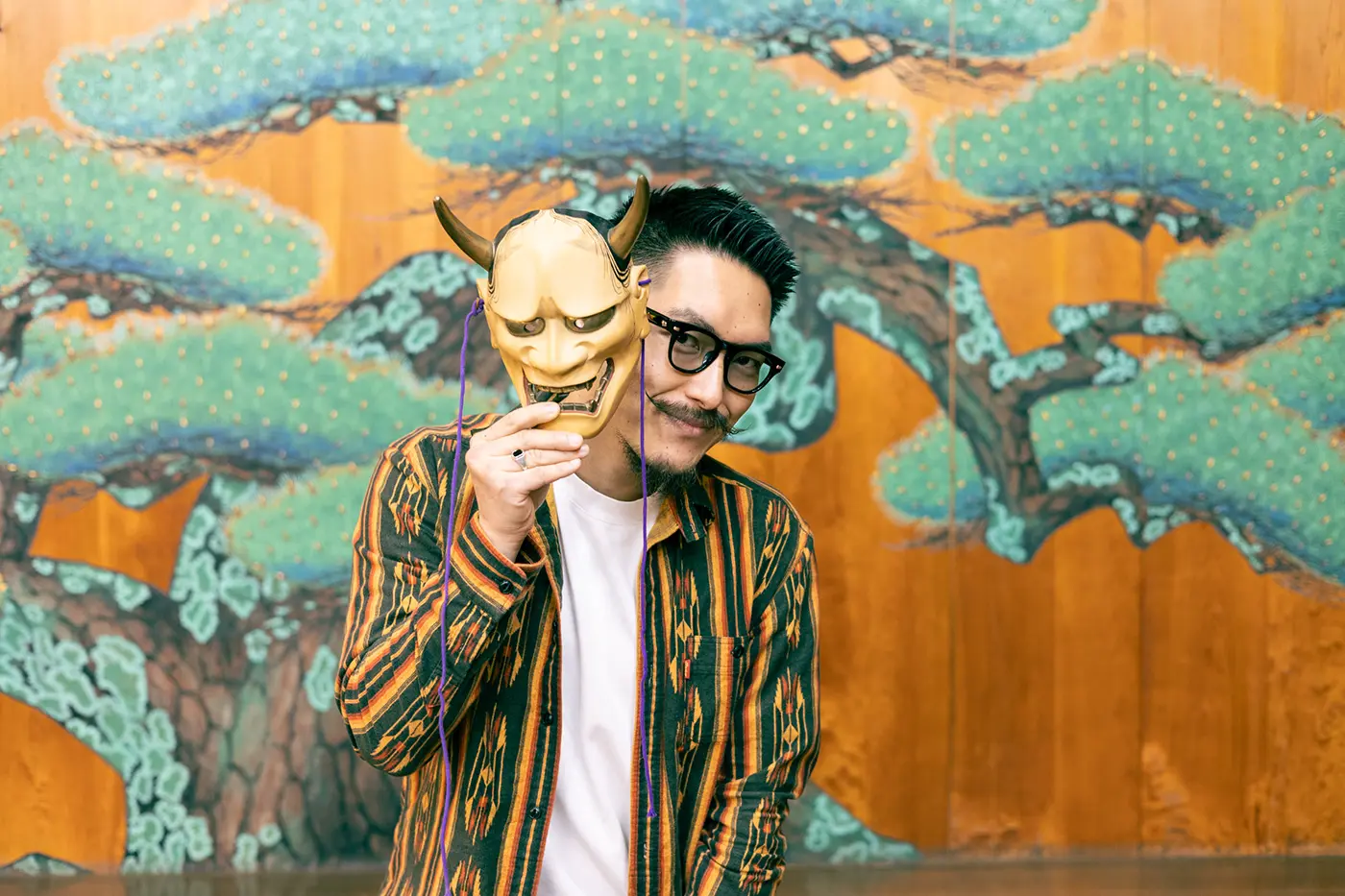
Of course, the lineup also includes the highly popular Hannya mask, which is one of the most popular female Noh masks. Incidentally, Hannya is the form of a woman who transforms into a demon out of jealousy or anger, but in reality, it is the state just before she transforms into her final form, a "shinja" (true snake). Taking a commemorative photo with the mask in hand in a space that is full of the world of Noh is the perfect memory of your trip to Kishiwada.
Enjoy a cafe time at MYOJYUNKA, where you can watch the Noh stage.
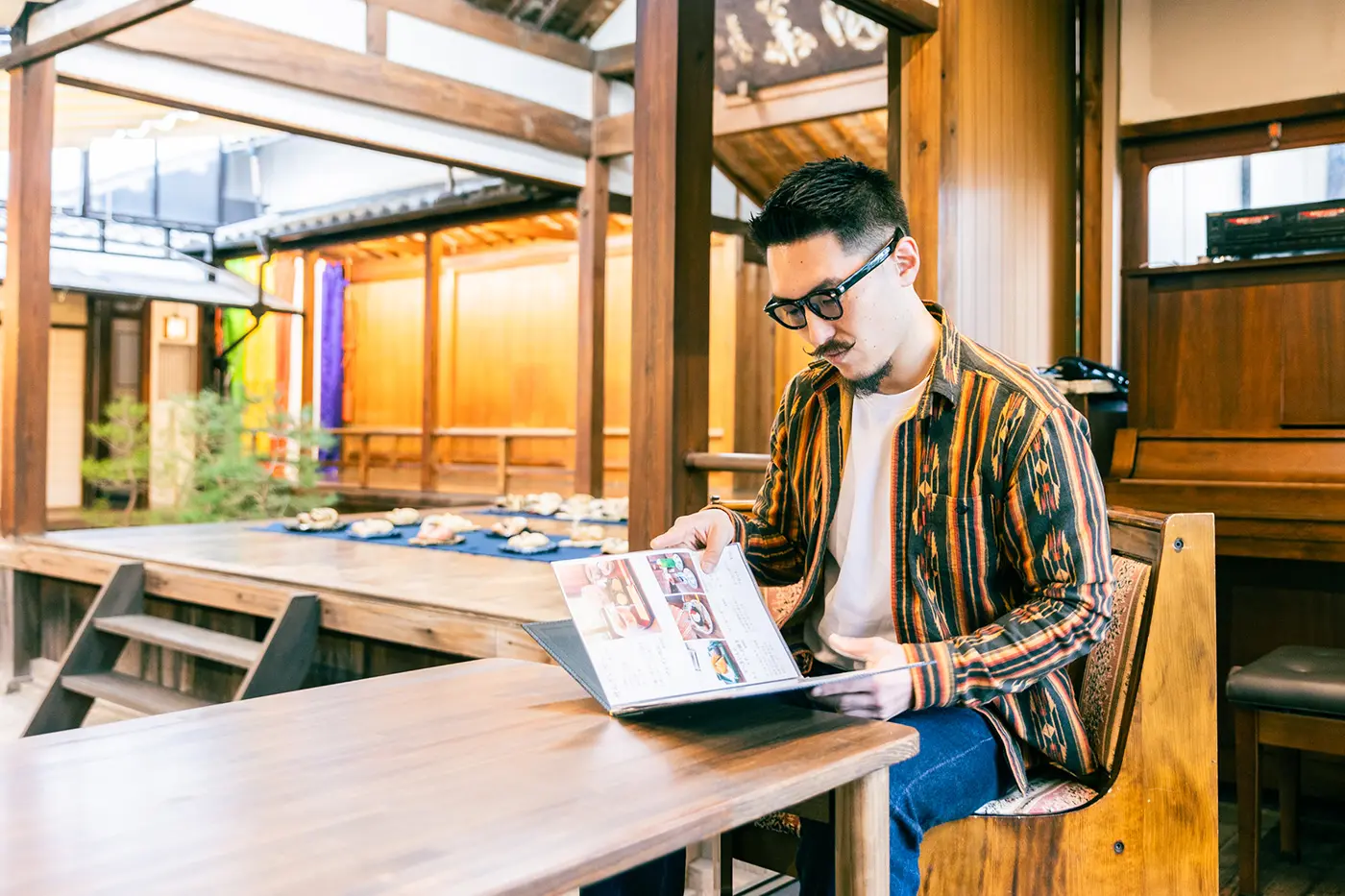
The restaurant "MYOJYUNKA" inside the Sugie Noh Theatre is open for lunch and as a cafe, offering meals that are good for your intestines and Japanese-style sweets. Dining in the same space as the historic Noh stage is an experience like no other.
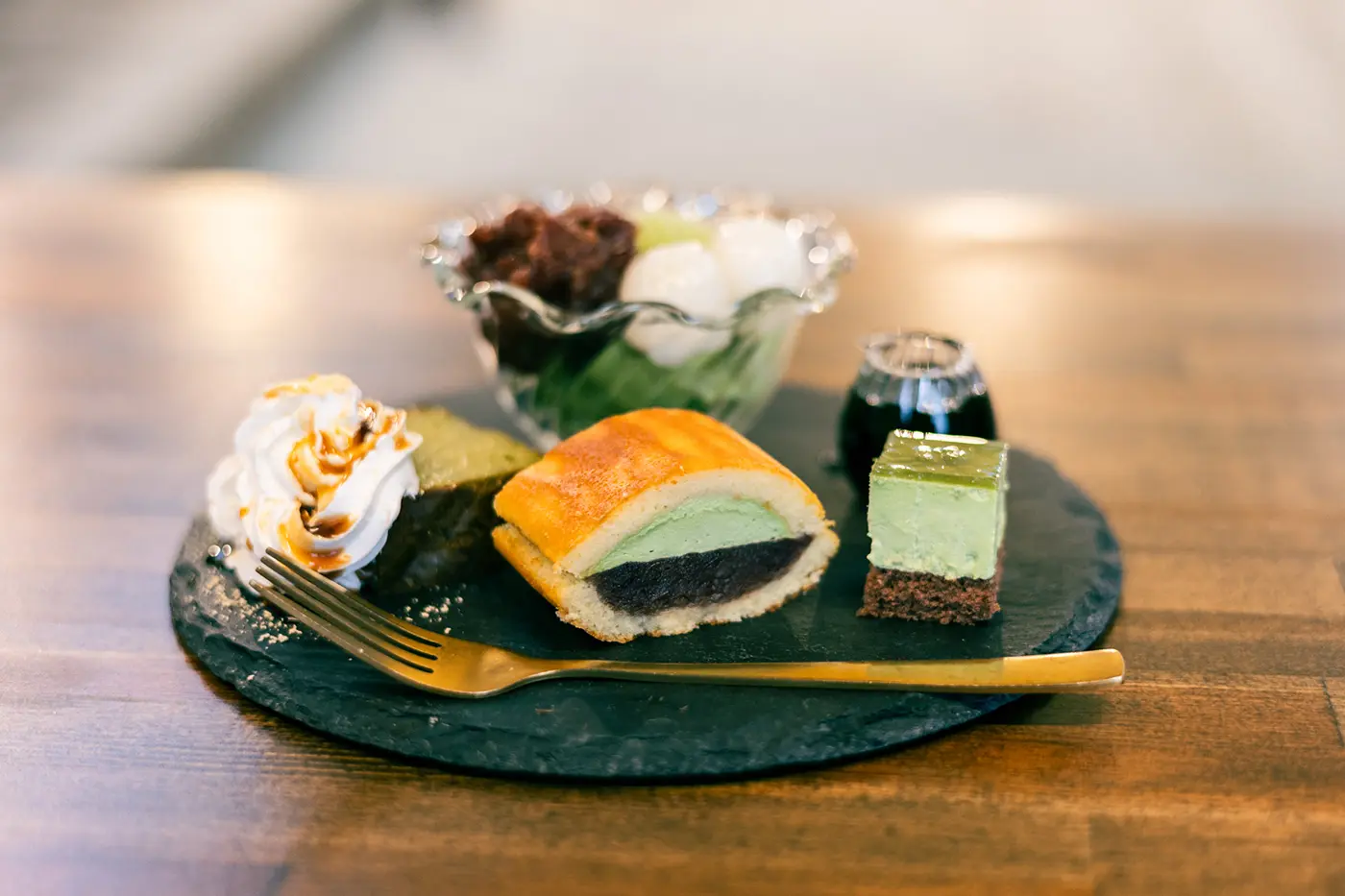
This time, I ordered the Matcha Plate (1,200 yen including tax), which is made with plenty of matcha, including dorayaki, cake, and ice cream.
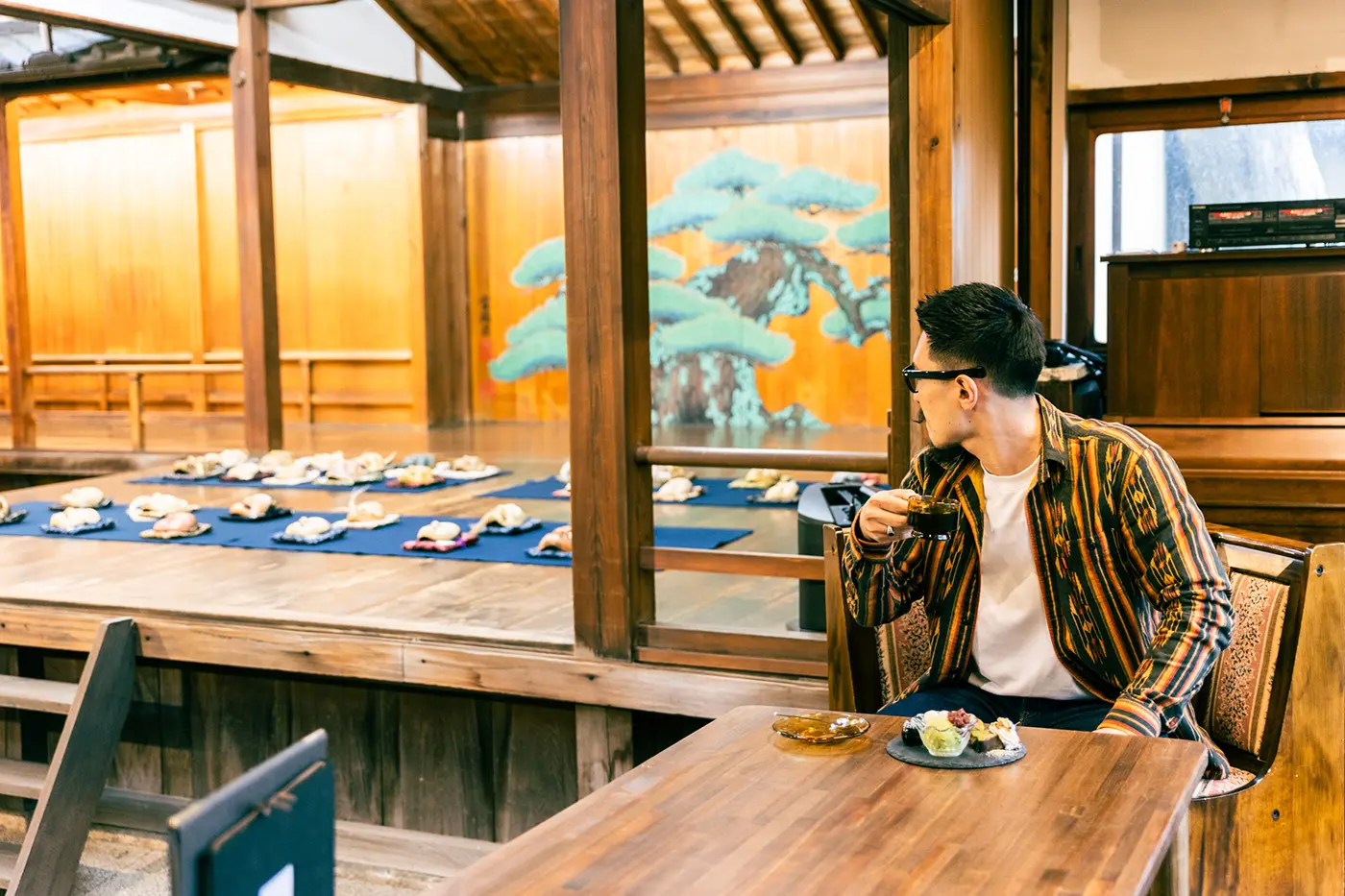
Kurimoto-san was still excited as he savored the sweets. Although he had been researching Noh and Noh masks, this was his first time actually performing on a Noh stage, and he was delighted to have learned so much.
It was quite intimidating to wear a Noh mask on such a historic Noh stage, but thanks to this experience I was able to gain a deeper understanding of the charm of Noh. I would like to visit again on my own time and enjoy the delicious food and Noh performance.
Not only were the Danjiri floats exciting, but the Noh performances were also exciting! Discover new charms of Kishiwada!
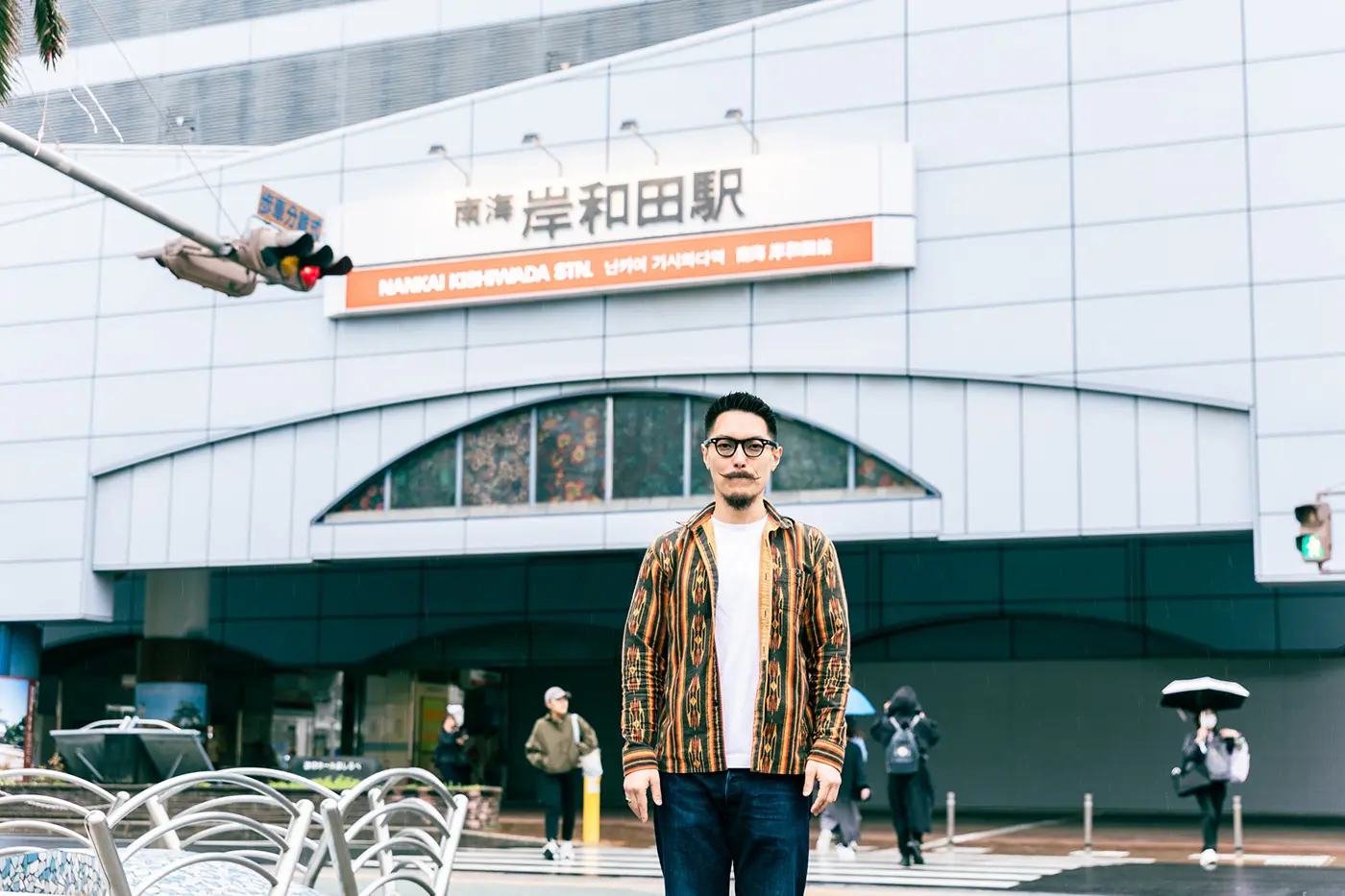
This was Kurimoto's first visit to Kishiwada City. He knew it was a region where danjiri floats are popular, but he never imagined that it would also be an area with such a strong connection to Noh masks, which he loves, and he often showed expressions of surprise throughout the interview.
Kishiwada is also known for its passion for classical performing arts. It's only about 30 minutes from Namba, so be sure to stop by and enjoy the area!
*The information in this article is current as of January, 2026. As details may have changed, please check the official websites of the facilities and stores for the latest information.
Photo: Yuji Takatsu
Edit: Yuji Takatsu
Direction: Ningen Henshusha
Related Tours
Cultural Tour of Osaka's Oldest Noh Stage and Kishiwada Castle
- Experience performing on stage at Sugie Noh Theater, the oldest surviving Noh theater in Osaka Prefecture
- Take a commemorative photo while holding and wearing a precious Noh mask
- Visit Kishiwada Castle, the symbol of Kishiwada
