 Copy Link
 X
X
 Facebook
 LINE
LINE
 LinkedIn
 Pinterest
 WhatsApp
 KakaoTalk
 NAVER
NAVER
 Weibo
Weibo
 WeChat
 Mail
Mail
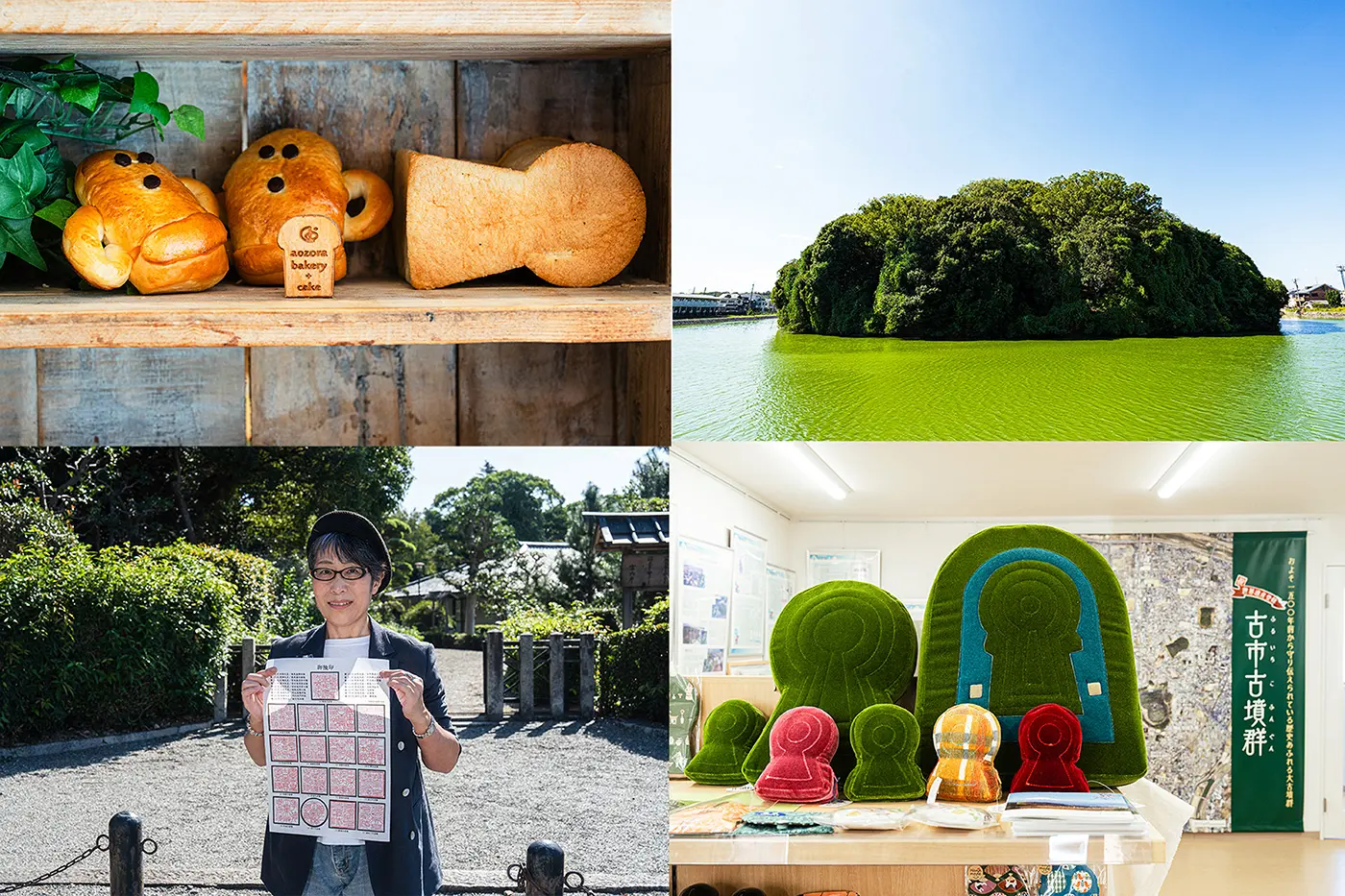

Habikino City is a city that vividly conveys the history and culture of the Kofun period. Home to a concentration of large keyhole-shaped tombs, which are part of the Mozu-Furuichi Kofun Group, a World Heritage Site, it is one of the centers of kofun culture. Together with Osaka-based novelist Kyoko Hasumi, we'll introduce a recommended itinerary for touring kofun and historical sites, enjoying lunch and souvenir shopping while also experiencing the romantic atmosphere of history.
Related Tours

Osaka: Experience Japanese history and culture with a Haniwa clay figure making experience in a World Heritage Site area
- Create your own one-of-a-kind haniwa in a place where many haniwa were made during the Kofun period, approximately 1,500 years ago.
- Making haniwa usually takes more than a month, but thanks to the use of special clay, you can take it home on the same day.
- While you wait for the food to be cooked, you can take a leisurely stroll around the Emperor Ojin Tomb and a shrine with a history of about 1,000 years.

Habikino City, located in the southeastern part of Osaka Prefecture, is home to the tomb of Emperor Ojin, one of the largest in Japan, as well as several large keyhole-shaped tumuli that are part of the Mozu-Furuichi Kofun Group, a World Heritage Site.
Many elaborate haniwa were also created in the Furuichi Kofun Group. These haniwa can be seen up close at the Habikino City Cultural Properties Exhibition Room. Nearby, there are also remains of the kilns where the haniwa were fired.
In addition to their historical value, kofun and haniwa are also popular for their form and their very existence. Habikino City, where kofun are found all over the city and where you can even experience making haniwa, is a popular destination for kofun enthusiasts. Our guide to Habikino City, where ancient history lives on, will be novelist Hasumi Kyoko, originally from Sakai City, Osaka Prefecture.

Hasumi is the author of Haniwa Rason: Revitalizing the Town with a Marathon!, a novel set in a "town of ancient burial mounds" in Osaka, and apparently became interested in ancient burial mound culture through his research.

The story of "Haniwa Rason" centers around the city hall employee, who, upon receiving an unreasonable request from the new mayor, rushes to organize a town revitalization marathon. Leading a preparation team made up of amateurs, he overcomes one problem after another, including the difficult course design, explanatory meetings for opposing residents, and a lack of funds.
The novel features three fictional cities. When Hasumi visited Furuichi in Habikino City for research, he was drawn to the relaxed atmosphere of the area and decided to make it the central setting for the story. Throughout the work, the townscape surrounded by ancient tombs is depicted through the eyes of the characters, and Osaka-style interactions appear throughout.
We will introduce a model course where you can enjoy lunch, activities, and souvenir shopping while experiencing the charm and history of the ancient tombs.
Guide

Novelist. Born in Sakai City, Osaka Prefecture. Graduated from the Department of Fine Arts at Osaka University of Arts. Made his debut in 2010 with "Female Jockey," which won the Excellence Award at the 30th Yokomizo Seishi Mystery Awards. In 2020, he won the 8th Osaka Honmahon Award for "Takoyaki no Kishimoto." Recent works include "A Summer Spent with a Mermaid," "Kobe Kitano Medico Penna: We'll Answer Your Fountain Pen Questions," "Flying with You: Horse Racing School Jockey Course," and "Haniwa Rason: Revitalize the Town with a Marathon!"
Take home "Haniwa and Kofun" bread, full of local love

The course begins at Furuichi Station on the Kintetsu Minami Osaka Line. The first place we visited was Aozora Bakery, a five-minute walk from the station. A beloved local bakery for over 10 years, the cute interior is lined with delicious-looking breads.

Aozora Bakery's popular products are "Hani-chan," a slightly sweet bread modeled after a haniwa clay figure, and the fragrant wheat "Keyhole-shaped Tumulus Bread." The Keyhole-shaped Tumulus Bread has been on sale since before the Mozu-Furuichi Kofun Group was registered as a World Heritage Site in 2019, as a way of showing support for the area. You can really feel the love for the local area.


The Hani-chan and Keyhole-shaped Tomb Bread are so cute! They make a great souvenir or a great companion for your tour of the ancient tombs. If you're worried about them selling out, we recommend calling to reserve yours.

An ancient tomb located close to where people live

A short walk from Aozora Bakery will bring you to Shiratori no Mausoleum, the closest ancient tomb to Furuichi Station.
This ancient tomb, located near a residential area, was designated by the Imperial Household Agency as the Swan Mausoleum of Yamato Takeru (Prince of Emperor Keikō). The legend of the swan tells of Yamato Takeru transforming into a swan, descending to the area, and then flying away, trailing his wings, is said to be the origin of the name Habikino city, and this important place is also the origin of the name.

"Habikino gives me the image of a vast sky," says Hasumi. He says he is attracted to the fact that it has not become an overly touristy area, and that precious places that have continued in people's lives since ancient times remain.
The road that passes in front of the temple is the Takeuchi Kaido, Japan's oldest official road, which was established as a "highway" during the Asuka period. From this historic road that connects Sakai and Nara, you can gaze upon the ancient tombs and think back to ancient times.
The lush greenery is soothing. Another charm of this town is that the houses are located right next to the ancient tombs. It feels like you're walking through someone's garden, and it's great to have an ancient tomb in the middle of it all.

Check out the popular Kofun Curry! A waterside cafe surrounded by ancient tombs

It takes about 15 minutes to walk from Shiratori Tomb to Flower Takeuchi Kaido Karusato store.
This is a Western-style pastry and bread shop that is particular about the ingredients it uses, and at the Takeuchi Kaido Karusato store you can enjoy healthy cafe menu items made with naturally grown rice.

We had the "Furuichi Kofun Group Curry." This dish was created to commemorate the area's registration as a World Heritage Site in 2019, and its visual design, modeled after a keyhole-shaped tumulus, is popular among kofun fans.
The rice is a blend of naturally grown rice from Wakayama Prefecture and rice grown with spring water from Mount Katsuragi in Minamikawachi District, Osaka Prefecture, and is polished for two minutes to ensure that all nutrients are retained. Topped with seasonal vegetables grown on the restaurant's own farm and local farmers, this curry is not only delicious but also healthy.

For dessert, try "Madame Yoko," a signature dessert with a soft, fluffy texture and a hint of cream cheese.


In addition to Shiratori Tomb, there is also Minegazuka Tomb in the surrounding area, making it the perfect place to take a break during your tour of the tombs. This pleasant cafe has large windows with a view of the pond and sky in front of you. The curry is mildly spicy, and you can enjoy a variety of vegetables, which is a nice touch.

Cafe: 9:30-17:00 *Last orders 16:30
There's even a manhole cover designed by Yu Darvish, a major league baseball player from Habikino City!
There is a slightly unusual manhole in the community plaza of the Habikino City Life and Culture Information Center LIC Habikino, located across Takeuchi Kaido from Flower.

This manhole cover features a design of Yu Darvish, a major league baseball player from Habikino City.
This is part of a manhole cover project designed by 12 Japanese players organized by MLB (Major League Baseball), and by scanning the QR code with your smartphone, you can enjoy a short AR movie.
See valuable materials up close! Habikino City Cultural Property Exhibition Room

After walking for about 20 minutes from the design manhole, we arrived at the Habikino City Cultural Properties Exhibition Room.
This is Hasumi's favorite spot.
This exhibition room, which opened in 2014, preserves and displays over 100 haniwa and burial goods excavated from various parts of the Furuichi Kofun Group. A major feature is that most of the items can be viewed directly, rather than behind glass cases.

When one thinks of haniwa, the first thing that comes to mind is a human-shaped haniwa with eyes and a mouth.
However, this exhibition room displays many older cylindrical haniwa, as well as figurative haniwa in the shapes of houses and animals. All of these are valuable pieces, and being able to look at them carefully from any angle is a rare experience (though please be careful when viewing!).


Another point that Hasumi recommends is that when you visit the exhibition room, you will be guided by staff from Habikino City's Cultural Properties and World Heritage Office. Not only can you ask any questions you have about the exhibits, but you can also ask about a wide range of topics, including excavation surveys and the preservation of ancient tombs.

This is my top pick. It's also great to be able to talk directly to the staff. If there's something I'm curious about, I'll ask lots of questions. This time, I asked, "Some burial mounds have been destroyed in the past, but what are the standards for preserved burial mounds?" and they explained it clearly while looking at a map. I also recommend seeing the precious grave goods excavated from the nearby Minegazuka Tomb. You'll be amazed at the intricate craftsmanship of the ornaments called gyohai and flower-shaped decorations.

Get up close and personal with historical sites. View the remains of ancient tombs and haniwa kilns adjacent to the residences.

Located very close to the Habikino City Cultural Property Exhibition Room is the Hakayama Tomb. Surrounding it are several kofun that appear to be secondary tombs attached to the Hakayama Tomb, and the highlight is the easy-to-see keyhole-shaped tumulus.


While you're here, why not also visit Nishiumazuka Kofun, a burial mound located in the center of the Furuichi Kofun Group and adjacent to a residential area?


A short walk from Nishiumazuka Kofun to the opposite side of National Route 170 will take you to the Konda Shiratori Haniwa Production Site, the remains of a kiln where haniwa were fired. Discovered by chance in 1969, the haniwa kiln is a pit kiln measuring 6-7m in length and 1.5m in width, and 11 kiln sites have been identified to date. This suggests that haniwa production was thriving in Konda, the local area of the Furuichi Kofun Group, from the 5th century to the first half of the 6th century.


A charming spot where you can buy ancient tombs and haniwa items as souvenirs and experience making haniwa.

A five-minute walk from the Honda Shiratori Haniwa Production Site will take you to a building decorated with unique haniwa figures.
Kawachi Konda Haniwa no Sato Okuraya is a facility that promotes the appeal of ancient tombs and haniwa.

Once inside, you'll find a wide selection of goods with motifs of ancient tombs and haniwa.
As the store is run by a printing company, it has a particularly wide selection of original stationery items, with many customers purchasing sticky notes, clips and other items.


"Okuraya has been very helpful to me. Not only do they stock Haniwa Rason in their store, but they also sell my books at my lectures and events," says Hasumi. The store also plays a major role as a spot to promote the appeal of kofun and haniwa, hosting events and hosting the "Kofun Gallery," which displays documents, pamphlets, and large aerial photographs of the Furuichi Kofun Group.

They also sell "Imperial Tomb Seal Mounting Paper" here.

A "Goryo-in" is a certificate that can be received when visiting a burial mound, and there are 17 Goryo-in available at the Mozu-Furuichi Kofun Group. If you go down to the floor below the sales floor, you will find a workshop space where you can experience making haniwa.

The experience is held twice a day for 90 minutes, and first you will be taught how to make ancient haniwa. After that, you will be free to create your own original haniwa.
Looking at the works on display, there are a variety of shapes, including unique doll haniwa and cute, relaxed animal haniwa. It is an experience that can be enjoyed by both children and adults, and is so popular that there are even repeat visitors.


Both the staff and the workshop participants were all skilled at making haniwa. They were all very unique, with some using their favorite characters as motifs, and others being original haniwa made by shop owners to display in their stores. I enjoyed just looking at them.

The largest in Japan! The huge, forest-like "Emperor Ojin's Mausoleum"

A 15-minute walk from Kawachi Konda Haniwa Village Okuraya will take you to the Emperor Ojin Tomb, the largest in the Furuichi Kofun Group.
With a total length of approximately 425m, it is the second largest keyhole-shaped tumulus in Japan, but is the largest in terms of volume. The height of the circular rear part is 36m, and the volume of the tumulus is 1.43 million cubic meters.
It is believed to be the tomb of a great king from the first half of the 5th century, and is designated as the "Tomb of Emperor Ojin" by the Imperial Household Agency, making it a representative of the Furuichi Kofun Group. The site of the outer bank of the outer moat on the west side, where fields of rapeseed flowers spread in spring, is also a nationally designated historic site.
The lush forest growing on the mound of Emperor Ojin's tomb is said to have grown naturally, untouched by human intervention. Speaking of ancient tombs, the tomb of Emperor Nintoku is famous, but I felt it was my role as a novelist to draw attention to the area and say, "Over here, you'll find Emperor Ojin!" So I visited the area many times to gather information. I also depicted the scene in "Haniwa Rason" modeled on the tomb, and when I come here, the air is truly sacred, and it feels different from the outside. When I think about how ancient people carried soil here and built the large mound, I get a strong sense that this place is connected to ancient times.
At the Imperial Household Agency's Furuichi Tomb Supervision Office, located to the north of Emperor Ojin's tomb, you can receive the 17 tomb seals that are under its care. If you ask the office staff, they will give you the tomb seals, and you can stamp each one yourself.

It was my first time stamping a mausoleum seal, so I was a bit nervous. There are only five places in Japan that have mausoleum seals, so I hope everyone who visits will get one as a memento.
The last stop on the course is Japan's oldest Hachiman Shrine, Konda Hachimangu Shrine

Located south of the tomb of Emperor Ojin, Hachiman Shrine is the oldest in Japan and is said to have been founded in the late 6th century. Emperor Ojin is enshrined as the main deity, and in addition to being worshipped for safe childbirth and protection from evil, he is also worshipped as the patriarch of commerce and industry, and the parent deity of scholarship and the arts.

View the ancient tombs in Habikino, a town surrounded by World Heritage sites, and imagine the ancient past

After we finished walking the course, Hasumi told us, "The view of the ancient tombs and the sunset from the train window is also beautiful."
Habikino City is a city where ancient ruins still live alongside the people of today. The wide open skies and relaxed atmosphere seem to have remained unchanged for over 1,500 years.
Walk through the townscape surrounded by World Heritage sites and experience the connection between the past and present.
*The information in this article is current as of December, 2025. As details may have changed, please check the official websites of the facilities and stores for the latest information.
Photo: Satoru Kitagawa
Edit: Press Labo
Direction: Ningen Henshusha
Related Tours
Osaka: Experience Japanese history and culture with a Haniwa clay figure making experience in a World Heritage Site area
- Create your own one-of-a-kind haniwa in a place where many haniwa were made during the Kofun period, approximately 1,500 years ago.
- Making haniwa usually takes more than a month, but thanks to the use of special clay, you can take it home on the same day.
- While you wait for the food to be cooked, you can take a stroll around the Imperial Tombs and a shrine with a history of about 1,000 years.
