 Copy Link
 X
X
 Facebook
 LINE
LINE
 LinkedIn
 Pinterest
 WhatsApp
 KakaoTalk
 NAVER
NAVER
 Weibo
Weibo
 WeChat
 Mail
Mail
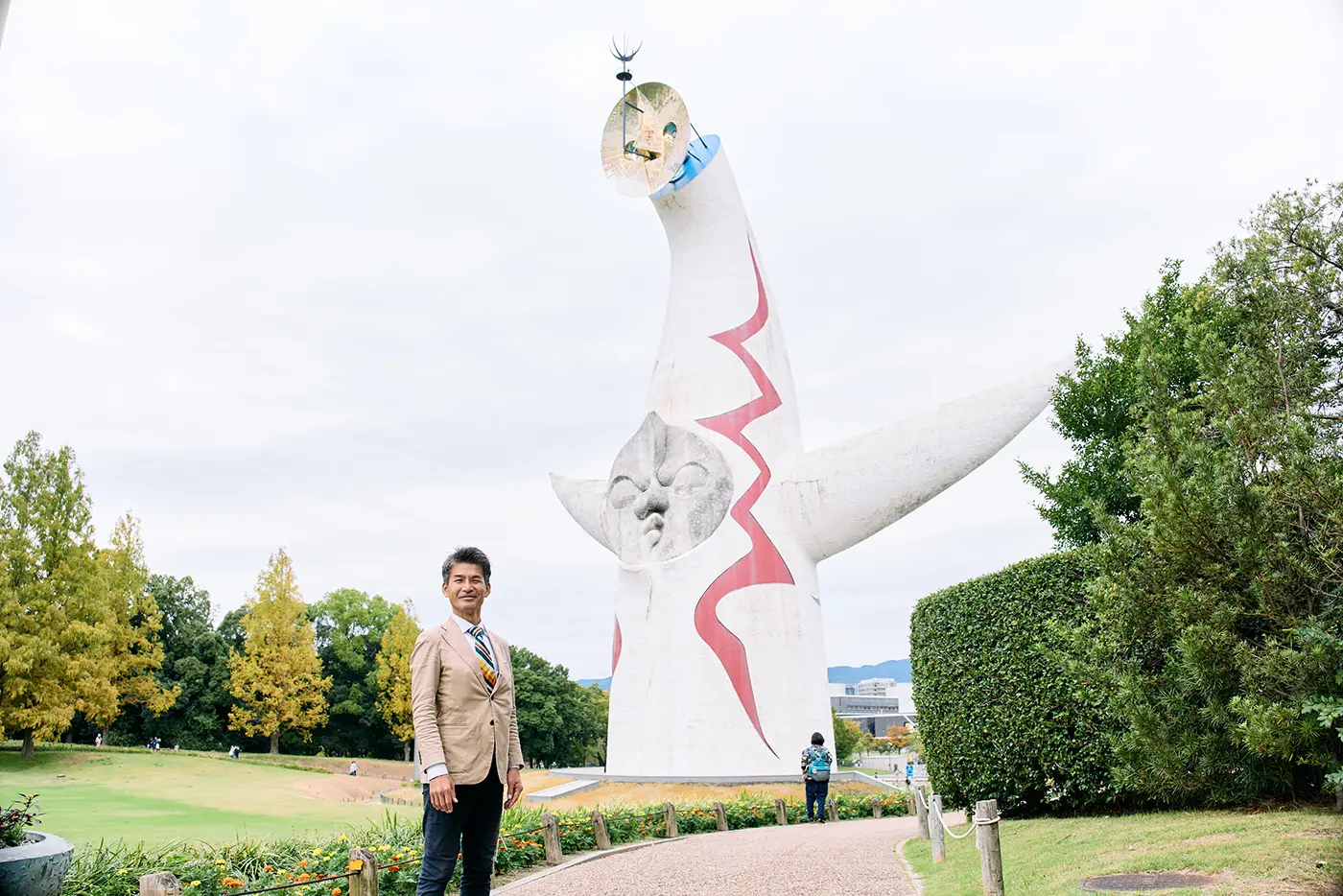

The Osaka-Kansai Expo, held in Yumeshima, Osaka, will sadly come to a close in October 2025. It has been announced that two of the hugely popular Miyaku Myaku monuments at the venue will be relocated to Expo'70 Commemorative Park, the site of the 1970 Japan World Exposition (EXPO '70). We will tour the park, which is home to the legacies of both the old and new Expos, with Expo enthusiast Atsushi Futagami.
Related Tours

Osaka: Expo'70 Commemorative Park Guided Tour, including the Tower of the Sun, Japanese Garden, and Pavilions
- Visit the facility where Asia's first World Expo pavilion still stands. Experience the excitement of Japan's rapid economic growth.
- See the impressive Tower of the Sun, designed by Taro Okamoto, a symbol of the area, up close
- Stories of history and the future told by professional guides
When you think of Suita City, you think of it as a city rich in greenery, with excellent access from central Osaka. It also has an image of a high-grade cultural city with a concentration of hospitals, universities, and research facilities. But there's one more thing we shouldn't forget when talking about Suita City...

55 years ago, the legendary event symbolizing Japan's period of rapid economic growth, the 1970 World Exposition*1, took place.
The scale of the Expo back then was astonishing, with the venue being roughly twice as large and the number of visitors more than doubled compared to the 2025 Expo! The Expo'70 Commemorative Park, which we will introduce today, was built on the vast site of that event.
In the future, the Miyaku Myaku Monument from the 2025 World Expo is also scheduled to be relocated here. This will be a place that will truly become the "Holy Land of the World Expo," where new and old legacies come together.
*1: To distinguish between the two Expos, the 1970 Expo will be referred to as "Expo 70" and the 2025 Expo will be referred to as "Expo 2025."
*2: The number of visitors to the 1970 Expo is expected to be approximately 64 million, while the number to the 2025 Expo is expected to be approximately 29 million.
Our guide around Expo'70 Commemorative Park will be Atsushi Futagami, an Expo enthusiast.
Futagami is a "specialist for the 1970 Expo" who has been guiding visitors around Expo'70 Commemorative Park for many years, making full use of his dignified posture, handsome voice, and speaking skills that are like those of a stand-up comedian (he knocked out the entire reporting team).

From the central gate, you can see the Tower of the Sun, the symbol of Expo '70. Enjoy the photos and the Expo knowledge that Futagami-san has to offer!

By the way, this park is huge so be prepared.
Guide

Expo enthusiast/ Expo'70 Commemorative Park Park tour guide. Starting with Portopia Expo (1981) when he was 8 years old, he is an Expo and Expo enthusiast who has visited 16 Expos and over 170 expos. In addition to his office job, he also works as a tour guide at Expo'70 Commemorative Park on his days off and will be working as a volunteer staff member at the 2025 Osaka-Kansai Expo. He is a hardcore fanatic who has visited the venue almost every day since it opened. He has also appeared on radio and television to spread information about the Expo. He travels all over the country to any exposition that has the word "exposition" in it.
How big is it?! A natural park born on the site of the former Expo
First, let's review.
"Banpaku" is an abbreviation of "World's Fair," and is the name given to an international exhibition where multiple countries exhibit their technology, culture, and art.
World's Fairs began with the first one (1851) in London, England, a country experiencing rapid growth due to the Industrial Revolution, and have continued to be held in countries around the world, including the fourth one (1889) in Paris, where the Eiffel Tower was built.
Then in 1970, Japan was chosen to host the first World Expo in Asia. The venue was Senri Hills, where Japan's first large-scale new town, Senri New Town, was born.
Just 25 years after Japan's defeat in World War II, in the midst of a period of rapid economic growth, a "city of the future" was born in this land that was once covered with bamboo forests, lined with pavilions from around the world.


Today, we will explore the remains of that time, visiting the Tower of the Sun, a symbol of the 1970 Expo, the former Steel Pavilion (EXPO'70 Pavilion) which is now used as a memorial hall, and the Natural and Cultural Gardens which contain them, before finally touring the Japanese Garden which was a government exhibition facility.
The theme of the 1970 World Expo was "Progress and Harmony for Mankind." How did people feel when they visited the venue, which brought together cutting-edge technologies from around the world, in an era before mobile phones and smartphones?

An antithesis to "progress and harmony of mankind"? Taro Okamoto's challenging design
When you think of Expo'70 Commemorative Park, the first thing that comes to mind is the Tower of the Sun. This monument, designed by Taro Okamoto, stands tall with an incredible presence just inside the central entrance (it can even be seen from the monorail).


The Tower of the Sun was originally designed as part of the "Theme Pavilion" that expressed the unifying theme of the Expo, "Progress and Harmony for Mankind."
In fact, when Taro Okamoto was asked to produce the Theme Pavilion, he was reluctant to take part. He felt that modernization was robbing humans of their primitive vitality, and so he was not convinced by the Expo's theme, "Progress and Harmony for Mankind."
However, Okamoto ultimately decided to accept the project. His passion can be seen in the Tower of the Sun, an alien object that breaks through the large roof of the Theme Pavilion.

The interior of the Tower of the Sun can be toured by reservation. Be sure to immerse yourself in the exploding world of Taro Okamoto.

There is talk of cleaning the Tower of the Sun, but I think it still has a certain charm as it is.
Finally, I'd like to leave you with some of Taro Okamoto's famous quotes.
"What progress? Humanity has not progressed at all."
"Harmony that requires everyone to compromise is despicable."
"I'd rather die than repeat the same thing again"
With this powerful message engraved in your mind, let's head to the "EXPO'70 Pavilion," also known as the "Former Steel Pavilion," a memorial hall for the 1970 World Expo! Let's go and feel the real atmosphere of that time.
The excitement of 1970 awaits in the existing pavilion, the Old Steel Pavilion!
At the entrance, Mr. Futagami first teaches us about the origin of the logo mark at that time.

The cherry blossom petals represent the world's five continents, and the circle in the middle represents the rising sun (Hinomaru, or Japan). This design was created by Takeshi Otaka, who also designed the packaging for Nissin Foods' Cup Noodles.
By the way, if you remove the eyes of the Myaku Myaku, it turns out to be the logo mark of the 1970 World Expo. The design of this logo mark inherits the spirit of the 1970 World Expo.

As you go up the stairs at the entrance, you will come across a large diorama, which gives you a bird's-eye view of the entire venue from that time.

Nowadays, the symbol of Expo'70 Commemorative Park is the Tower of the Sun, but at the time its real symbol was the 127-meter observation tower, the Expo Tower.

The tower was designed based on the "metabolism theory," which states that buildings change organically to adapt to people, rather than people adapting to the building. The spheres attached to the tower were designed to be removable depending on the purpose.
The demolition of the Tower of the Sun was suddenly canceled due to the wishes of many people, including a letter from a boy who said, "I hope they can come up with a way to avoid having to demolish it." It's a powerful story! That boy was none other than Fujii Hideo, who later became famous as an "Expo maniac."
Futagami-san's knowledge has been endless since the start, but this is just the beginning. Now, let's enter a moody space.

An explosion of cutting-edge technology and style! A spacious music hall
The "Old Steel Pavilion" where we are now located was exhibited by the Japan Iron and Steel Federation as a sound and light pavilion.
The hall, called the "Space Theater," is likened to a giant musical instrument, and its avant-garde music and laser light shows were very popular. This is the hall that remains as it was back then. 1,008 speakers are installed in the ceiling, walls, and under the floor.
*Currently it is completely closed and can only be viewed through glass.

The first World Expo in Japan, and even the first in Asia. It was a huge project with no precedent, but the innovative planning gave the impression of a "Let's do it!" spirit.
Many common sense ideas were born here! The 1970 Expo that defined an era
Approximately 60% of the nation's population attended Expo 1970. Just before it closed, the number of visitors in one day exceeded 830,000 (roughly the population of Saga Prefecture at the time), and the frenzy was so out of control that approximately 4,000 people were unable to return home and were sleeping rough around the site. Furthermore, a woman went into labor at the Expo site and gave birth at an emergency hospital.

Under these circumstances, many cultural elements spread throughout Japan. For example, toilet signs with a male and female motif. At the time, pictograms were not yet common, so people were left wondering what was going on when they saw this sign.
In addition, foods that are now familiar to us, such as yogurt, French bread, and canned coffee, also became suddenly popular at the Expo.

In an era before mobile phones and the internet, the main means of communication was paper. The exhibition corners for the pamphlets displayed by each pavilion are also worth seeing.

Nowadays, it is common to scan QR code with a smartphone. While there are benefits such as no printing costs, when you look at it again, there is also value in leaving it on paper.
Come face-to-face with the original golden face!

Suddenly, a slope appeared, as if warping into another dimension.
Futagami-san is being sucked in. Where on earth will he end up?

At the end of the slope, there are many valuable exhibits, including hostess uniforms and commemorative stamps. This is the annex, which opened in August 2023. And the next moment...

BOOM!!!
The original "Golden Face" that was installed at the top of the Tower of the Sun during the 1970 World Expo suddenly appeared.

The Tower of the Sun has four faces. On the front is the "Sun Face" representing the present, on the top is the "Golden Face" representing the future, on the back is the "Black Sun" representing the past, and underground is the "Underground Sun". The Underground Sun has been missing since the closing ceremony.
The original golden face was made of zinc-plated steel, but because there was a high risk of rust, it has now been replaced with a stainless steel face.
There were also plenty of other exhibits to see in the annex. At this point, the reporting team began to realize, "We don't have enough time!"


*A separate admission fee is required for both the Natural and Cultural Gardens and the Japanese Garden.
Take a break in the Japanese garden at the very back of the park, a place only known to those in the know
After filling their brains with an incredible amount of information at the EXPO '70 Pavilion, the reporting team headed to the Japanese garden on the north side of the park in search of relaxation. This is a famous garden built by the Japanese government at the time, bringing together the best of Japanese landscaping techniques.

Once you pass through the main gate and proceed inside... you'll be greeted by a panoramic view of the strolling garden with a pond! Truly an exhibition that the government has poured its heart and soul into. The scale is beyond imagination.


The landscaping, which incorporates four styles - ancient, medieval, early modern, and contemporary - gently connects with the water flowing from west to east, creating a pleasant walking path. The central rest area facing the pond also has a Kissa space.
Futagami, who runs 100km marathons as a hobby, never gets tired no matter how much he walks. However, our reporting team is tired from all the walking, so it's time to take a break.


Now, it's time to resume our stroll. As we walk through the garden, new scenery appears one after another. There are many ways to enjoy the garden, from taking a leisurely stroll to reading a book.


Did you have a chance to relax surrounded by nature? I imagine that the people back then were also soothed by the unchanging beauty of nature after touring the futuristic pavilions. We also recommend the tea ceremony event, which is held for a limited time.

*Food (lunch) menu available from 11:00 to 14:00
*Last drink orders in the store are at 4:30pm
Expo '70 Expo'70 Commemorative Park: endless sights and great value for money

After walking around the park, we came back to the Tower of the Sun! It looks cool from behind too.
Thanks to Futagami's thorough guidance, we ended up not having enough time today! It was a day where we were constantly overwhelmed by the enthusiasm of Japan in 1970.
Although I can feel the energy of society at that time, those days will never return. With a bit of sadness, it's time to say goodbye to Futagami-san.
At the Yumeshima venue, plans are underway to preserve the large roof ring, but it looks like it will only be a small part of a cake, sliced into pieces. While there is a desire to preserve it for future generations, the maintenance costs are considerable. It's a tough decision.

Even so, the sheer scale of the park is a real surprise. There are many other interesting spots, such as the Japan Folk Crafts Museum, Osaka, which retains its appearance from the time of the 1970 World Expo, and the National Museum of Ethnology (commonly known as Minpaku), which opened in 1974. When you visit, be sure to try and find traces of 1970 in addition to the spots introduced today.

*The information in this article is current as of December, 2025. As details may have changed, please check the official websites of the facilities and stores for the latest information.
Photo: Mei Hirano
Edit: Rie Tomimoto
Direction: Ningen Henshusha
Related Tours
Osaka: Expo'70 Commemorative Park Guided Tour, including the Tower of the Sun, Japanese Garden, and Pavilions
- Visit the facility where Asia's first World Expo pavilion still stands. Experience the excitement of Japan's rapid economic growth.
- See the impressive Tower of the Sun, designed by Taro Okamoto, a symbol of the area, up close
- Stories of history and the future told by professional guides
